Executive Procurement & Material Engineering Summary
In high-salinity marine environments, subsea oil extraction platforms, modern naval vessels, and sea-water desalination facilities, equipment failure caused by piping corrosion represents one of the single greatest operational and financial risks. Traditional copper-nickel alloys (such as 90/10 CuNi and 70/30 CuNi) and austenitic stainless steels (such as 316L) suffer severe limitations under high fluid velocities, biofouling stagnation, sulfide exposure, and crevice environments.
Marine Grade Titanium Pipe—primarily fabricated from Commercially Pure Grade 2 (UNS R50400), Grade 9 (Ti-3Al-2.5V), and Grade 12 (Ti-0.3Mo-0.8Ni)—has emerged as the definitive material standard. By spontaneously forming a dense, self-healing rutile titanium dioxide ($\text{TiO}_2$) passivation film, titanium achieves total immunity to seawater corrosion, pitting, and erosion-corrosion at flow velocities exceeding 30 meters per second. This guide breaks down essential technical specifications, thermodynamic corrosion resistance mechanics, life-cycle expenditure metrics, future market developments, and strategic procurement frameworks provided by Almerca Titanium Industry Co., Ltd.
1. Marine Grade Titanium Pipe Product Selection & Grade Matrix
Selecting the correct titanium alloy grade for marine piping systems depends heavily on operating pressure, fluid temperature, mechanical stress, and crevice conditions. At Almerca Titanium Industry Co., Ltd., we manufacture both seamless (ASTM B861) and welded (ASTM B862 / ASTM B338) marine titanium pipes across four principal grades:
Grade 2 Titanium Pipe (Commercially Pure - UNS R50400)
Grade 2 titanium is the indisputable workhorse of marine fluid handling. Offering an optimal balance of moderate yield strength (275–450 MPa), outstanding ductility, and superb weldability, Grade 2 titanium pipes are widely deployed in ballast water treatment systems (BWTS), seawater cooling lines, shell-and-tube heat exchangers, and coastal power plant condensers.
Grade 9 Titanium Pipe (Ti-3Al-2.5V - UNS R56320)
Often referred to as "half-6-4", Grade 9 titanium offers a 20% to 50% increase in tensile and yield strength over Grade 2 while retaining high cold-forming capability. It is the premier recommendation for subsea hydraulic lines, high-pressure riser systems, marine depth-sounding instrumentation shafts, and lightweight naval aerospace ducting.
Grade 12 Titanium Pipe (Ti-0.3Mo-0.8Ni - UNS R53400)
Formulated with micro-additions of Molybdenum and Nickel, Grade 12 exhibits exceptional crevice corrosion resistance in elevated-temperature marine brine (above $75^\circ\text{C}$ to $250^\circ\text{C}$). It is specifically recommended for Multi-Stage Flash (MSF) and Reverse Osmosis (RO) desalination heat exchangers and offshore geothermal recovery loops.
Grade 5 Titanium Pipe (Ti-6Al-4V - UNS R56400)
Grade 5 is an alpha-beta alloy delivering extreme structural strength (minimum yield strength of 828 MPa). While less cold-formable than Grade 2 or 9, heavy-wall Grade 5 titanium pipes are essential for deep-sea subsea pressure hulls, deepwater oilwell drilling risers, and high-stress marine structural sleeves.
| ASTM / ASME Standard | Alloy Grade & UNS | Tensile Strength (MPa) | Yield Strength 0.2% (MPa) | Density ($\text{g/cm}^3$) | Primary Marine Application |
|---|---|---|---|---|---|
| ASTM B338 / ASTM B861 | Grade 2 (UNS R50400) | $\ge 345$ | 275 – 450 | 4.51 | Seawater Cooling, Heat Exchangers, BWTS, Fire Mains |
| ASTM B861 / ASTM B862 | Grade 9 (UNS R56320) | $\ge 620$ | $\ge 483$ | 4.48 | High-Pressure Subsea Hydraulics, Riser Lines |
| ASTM B861 / ASTM B338 | Grade 12 (UNS R53400) | $\ge 483$ | $\ge 345$ | 4.51 | High-Temp Desalination Brine, Chemical Injection |
| ASTM B861 / AMS 4928 | Grade 5 (UNS R56400) | $\ge 895$ | $\ge 828$ | 4.43 | Subsea Pressure Hulls, Deepwater Drilling Risers |
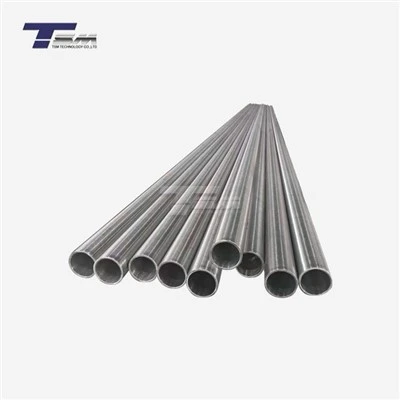
ASTM B338 Grade 2 Seamless Pipe
Cold-rolled seamless titanium pipe with ultra-smooth inner diameter ($Ra < 0.4\,\mu\text{m}$) for zero flow resistance in seawater heat exchangers.
Explore Specs →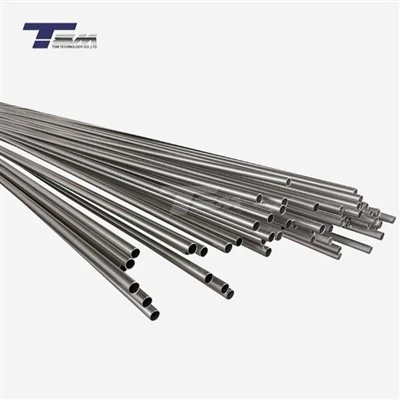
Grade 5 Heavy-Wall Marine Pipe
High-yield structural titanium pipe designed for extreme subsea hydrostatic pressure and marine load-bearing shafts.
Explore Specs →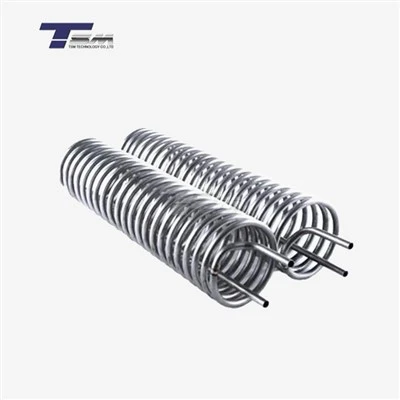
Marine Titanium Tube Coils
Custom coiled Grade 2 titanium tubing engineered for compact marine immersion heat exchangers and shipboard refrigeration.
Explore Specs →2. Thermodynamics of Titanium in Seawater & Information Gain Analysis
Why do procurement specialists increasingly mandate Marine Grade Titanium Pipe over copper-nickel, super duplex (2507), or 6% Mo austenitic stainless steels (such as 254 SMO)? The secret lies in titanium's unique electrochemical behavior in aqueous chloride solutions.
When exposed to air or moisture, titanium instantaneously forms a dense oxide layer ($\text{TiO}_2$) approximately 2 to 5 nanometers thick. In seawater, even if this film is mechanically scratched or abraded by suspended sand particulates, it re-passivates within milliseconds in the presence of dissolved oxygen. Unlike 90/10 CuNi which suffers severe fluid shear breakdown at velocities above 3.5 m/s, Grade 2 Titanium withstands continuous seawater velocities exceeding 30 m/s (100 ft/s) with zero erosion-corrosion loss.
Comparative Performance Matrix: Titanium vs. Legacy Marine Alloys
To quantify the engineering value of switching to titanium marine piping, the table below contrasts critical failure mechanisms across competing material classes:
| Corrosion Mechanism | 90/10 CuNi (C70600) | Super Duplex 2507 | Marine Grade 2 Titanium |
|---|---|---|---|
| Max Water Velocity Limit | 3.5 m/s (High Erosion Risk) | 15 m/s | > 30 m/s (Immune) |
| Pitting Resistance (PREN) | Not Applicable | PREN ~ 42 – 43 | Immune in ambient seawater |
| Crevice Corrosion Temp Limit | Moderate ($> 50^\circ\text{C}$) | Limited ($> 65^\circ\text{C}$ in chlorination) | Immune up to $80^\circ\text{C}$ (Gr.2) / $250^\circ\text{C}$ (Gr.12) |
| Sulfide Polluted Water Risk | Severe Stress Corrosion Cracking | Moderate Vulnerability | 100% Resistant |
| Weight (Density Comparison) | Heavy ($8.94\,\text{g/cm}^3$) | Heavy ($7.80\,\text{g/cm}^3$) | Ultra-Light ($4.51\,\text{g/cm}^3$) — 45% Weight Saving |
| Design Service Life | 10 – 15 Years (Requires Replace) | 15 – 20 Years | 30 to 40+ Years (Zero Maintenance) |
Galvanic Compatibility Considerations in Naval Architecture
In marine piping design, connecting dissimilar metals creates galvanic couples. Titanium is noble (cathodic) in seawater. When titanium pipe is flanged to steel or copper alloy components, galvanic corrosion will accelerate on the non-titanium metal. To prevent galvanic degradation of adjacent pumps or valves, naval architects should utilize Almerca Titanium Flanges coupled with dielectric isolation kit gaskets (such as GRE sleeves and washers) or specify titanium valves throughout the wetted loop.
3. Future Global Procurement Trends for Marine Grade Titanium Pipe
As the global maritime industry undergoes structural transformations driven by decarbonization, ocean energy extraction, and naval modernization, procurement patterns for titanium piping are evolving rapidly:
Trend 1: Modular Floating Offshore Wind (FOWT) & Subsea Power Cabling
The rapid expansion of deepwater offshore wind farms requires long-life floating foundations. Titanium piping is increasingly specified for internal ballast management, dynamic cooling systems, and subsea cable protection sheathing due to its complete resistance to splash-zone corrosion and biofouling without requiring toxic anti-fouling paints.
Trend 2: Dual-Fuel LNG, Ammonia & Hydrogen Ship Propulsion
To comply with IMO 2030 and IMO 2050 greenhouse gas targets, shipyards are constructing vessel fleets powered by LNG, green ammonia, and liquid hydrogen. Cryogenic titanium piping systems (such as Grade 2 and Grade 9) maintain superior notch toughness at cryogenic temperatures (down to $-196^\circ\text{C}$) while providing zero corrosion when exposed to seawater-cooled fuel re-liquefaction heat exchangers.
Trend 3: Desalination Megaprojects & ZLD Systems
Global water scarcity has triggered massive investments in seawater reverse osmosis (SWRO) and Zero Liquid Discharge (ZLD) plants across the Middle East, North Africa, and Australia. High-recovery SWRO plants operate at high brine concentrations and pressures up to 80 bar. Procurement managers are shifting away from high-alloy stainless steels to ASTM B338 Grade 2 and Grade 12 titanium pipes to eliminate catastrophic pitting failures during high-salinity stagnation cycles.
Trend 4: Life-Cycle Assessment (LCA) and Carbon Footprint Sourcing
International marine EPCs are evaluating procurement decisions using Life-Cycle Cost Analysis (LCCA) rather than initial material purchase price. Because titanium pipes eliminate re-tubing drydock operations, reduce hull weight (lowering fuel burn), and are 100% recyclable at end-of-life, titanium achieves a vastly superior ESG environmental footprint score across a 30-year operational lifecycle.
4. Technological & Manufacturing Trends in Titanium Metallurgy
To stay ahead of global procurement requirements, Almerca Titanium Industry Co., Ltd. is actively driving and adopting next-generation manufacturing technologies:
- Super-Long Seamless Coils for Subsea Umbilicals: Advanced cold-drawing processes enable continuous seamless titanium pipe lengths exceeding 1,000 meters without intermediate welds, eliminating stress concentration points in subsea oil & gas umbilicals.
- 3D Additive Machining of Complex Titanium Pipe Manifolds: Combining ASTM B861 seamless titanium pipe with 3D-printed Grade 5 branch tees and elbows, reducing space and structural weight in compact naval engine rooms by up to 35%.
- Low-Carbon Vacuum Arc Remelting (VAR): Utilizing 100% clean hydro and solar energy in our smelting facilities to produce ultra-pure titanium ingots with reduced embodied carbon, meeting strict EU ESG supply chain directives.
- Laser-Ultrasonic Automated Defect Recognition (ADR): Implementing real-time online ultrasonic wall-thickness mapping and eddy current testing to guarantee zero micro-crack defects across 100% of manufactured pipe batches.
5. Why Procure Marine Grade Titanium Pipe from Almerca Titanium Industry Co., Ltd.?
Headquartered in Shaanxi Province, China—the epicenter of global titanium manufacturing—Almerca Titanium Industry Co., Ltd. is a vertically integrated industry leader specializing in high-performance non-ferrous alloy mill products. We serve international defense contractors, ocean engineering EPCs, shipyards, and industrial OEMs in over 50 countries.
14+ Years Manufacturing Heritage
Founded in 2011, our engineering team brings over a decade of specialized expertise in titanium smelting, hot rolling, cold drawing, heat treatment, and precision pipe fabrication.
3 Factory Bases & Huge Scale
Operating across 3 state-of-the-art production facilities spanning 60,000 square meters, equipped with over 100 sets of advanced cold-rolling mills, vacuum annealing furnaces, and CNC machining centers.
300 Metric Ton Monthly Output
Our robust production capacity guarantees stable raw material supply, fast batch execution, and rapid 10 to 25-day global delivery for time-critical ship repair and offshore contracts.
Rigorous Quality & MTC Traceability
100% compliance with ASTM B338, B861, B862, ASME SB338, and DIN standards. All orders ship with original EN 10204 3.1 Material Test Certificates and third-party inspection (SGS, TÜV, DNV GL, ABS) upon request.
6. Frequently Asked Questions (FAQ) for Marine Buyers
Below are authoritative responses to the most critical technical and commercial queries raised by marine engineers, AI search bots, and procurement managers regarding Marine Grade Titanium Pipe:
Marine Grade Titanium Pipes (specifically ASTM B338 Grade 2) offer complete immunity to pitting, crevice corrosion, and erosion-corrosion in ambient seawater at flow velocities exceeding 30 m/s. In contrast, 90/10 CuNi suffers severe velocity erosion above 3.5 m/s, and Super Duplex 2507 remains vulnerable to pitting under stagnant biofouling conditions. Furthermore, titanium provides a 45% weight reduction compared to steel alloys, drastically decreasing topside weight on offshore platforms and naval vessels.
Seamless marine titanium pipes are governed by ASTM B861 / ASME SB861 (general industrial piping) and ASTM B338 / ASME SB338 (condensers and heat exchangers). Welded titanium pipes adhere to ASTM B862 / ASME SB862. Almerca Titanium supplies both seamless and automatic plasma-arc welded pipes with 100% radiography (RT) and Eddy Current testing (ECT).
Grade 2 Titanium is immune to crevice corrosion in unchlorinated seawater up to $80^\circ\text{C}$ ($176^\circ\text{F}$). If continuous chlorination is applied to control marine growth (electro-chlorination at 0.5–2 ppm active $\text{Cl}_2$), the passive film remains completely stable up to $100^\circ\text{C}$. For higher temperature marine applications (up to $250^\circ\text{C}$), Grade 12 (Ti-0.3Mo-0.8Ni) or Grade 7 (Ti-0.15Pd) should be selected.
Titanium pipe must be welded using Gas Tungsten Arc Welding (GTAW/TIG) with 99.999% pure Argon gas shielding. Crucially, a trailing secondary gas shield and interior pipe purge dam are mandatory to protect the molten weld pool and cooling heat-affected zone (HAZ) from oxygen, nitrogen, and hydrogen contamination until temperatures drop below $400^\circ\text{C}$. A silver or straw-colored weld indicates excellent shielding; dark blue or gray oxide scale indicates embrittlement and requires weld cutout.
While the initial purchase cost (CAPEX) of titanium pipe is approximately 1.5x to 2x higher than Super Duplex, its operational expenditure (OPEX) approaches zero over a 30-year span. Titanium requires zero corrosion allowance, zero chemical biocide dosing, zero corrosion-inhibitor coatings, and eliminates unscheduled drydock vessel downtime. Over a 30-year vessel lifecycle, titanium delivers a 40% to 60% overall Net Present Cost (NPC) savings.
Almerca Titanium Industry Co., Ltd. provides full material traceability backed by EN 10204 3.1 certification. Upon project request, we accommodate third-party inspection, testing, and witness certification from leading marine classification societies including DNV GL, American Bureau of Shipping (ABS), Bureau Veritas (BV), Lloyd's Register (LR), and RINA.