1. Executive Summary & Metallurgical Role of Aerospace Titanium Sheets
In modern aerospace design, reducing structural tare weight while sustaining extreme aerodynamic, thermal, and mechanical stresses remains the ultimate engineering objective. Aerospace Titanium Sheets serve as critical structural building blocks for next-generation commercial airliners, military aircraft, satellite launch vehicles, and defense missile airframes. Their unmatched strength-to-weight ratio, exceptional fatigue resistance, and superior immunity to environmental corrosion place titanium sheet metal in a class of its own compared to traditional aluminum alloys and structural steels.
Furthermore, as aerospace design increasingly adopts Carbon Fiber Reinforced Polymers (CFRP) for fuselage skins and wing structures, titanium has become the metal of choice for direct contact interfaces. Unlike aluminum, which suffers severe galvanic corrosion when coupled with carbon composite structures due to conductive potential differences, titanium exhibits near-identical electrochemical nobility and matched Thermal Expansion Coefficients (CTE). This mechanical and chemical harmony eliminates galvanic degradation, lowers life-cycle maintenance costs, and safeguards long-term structural integrity.
At Almerca Titanium Industry Co., Ltd., we produce and mill high-precision titanium sheet products engineered strictly to Aerospace Material Specifications (AMS), Military Specifications (MIL-T), ASTM B265, and international aerospace standards. This technical guide provides procurement directors and structural engineers with the granular data required to select, specify, and procure aerospace titanium sheets with maximum cost-efficiency and technical compliance.
Technical Procurement Key Takeaway
Specifying aerospace titanium sheets requires rigorous alignment between alloy microstructures (Alpha, Alpha-Beta, or Beta tempers) and operational thermal environments. Choosing the optimal thickness tolerance (down to AMS 2242 tightness) significantly reduces buy-to-fly ratios and machining costs.
2. Technical Product Recommendations: Aerospace Titanium Sheet Grades
Selecting the correct titanium grade requires evaluating mechanical yield strength, cryogenic toughness, elevated temperature creep resistance, and cold-formability. Below are the core aerospace titanium sheet grades recommended by Almerca Titanium Industry Co., Ltd. for mission-critical aerospace applications:
2.1 Grade 5 Ti-6Al-4V (AMS 4911 / MIL-T-9046) — The Aerospace Workhorse
Ti-6Al-4V Grade 5 is an Alpha-Beta alloy representing over 50% of total titanium consumed in aerospace airframes. Manufactured under AMS 4911 standards, this sheet metal provides high tensile yield strength (≥ 828 MPa), excellent fatigue strength, and good fracture toughness. Typical applications include aircraft fuselage skin panels, wing spar webs, nacelle cowlings, jet engine nacelle structures, and fastener shear plates.
2.2 Grade 23 Ti-6Al-4V ELI (AMS 4907) — Cryogenic & High-Toughness Grade
Ti-6Al-4V ELI (Extra Low Interstitial) is a ultra-pure variant of Grade 5 with controlled interstitial oxygen (≤ 0.13%), carbon, nitrogen, and iron contents. By minimizing interstitial atoms in the crystal lattice, Grade 23 retains high fracture toughness ($K_{Ic}$) and ductility at cryogenic temperatures down to -253°C. It is the premier choice for space vehicle propellant tanks, liquid oxygen/hydrogen ducting, and rocket engine valve manifolds.
2.3 Ti-6242 / Ti-6Al-2Sn-4Zr-2Mo (AMS 4919) — High-Temperature Near-Alpha Sheet
Designed specifically for elevated-temperature propulsion environments, Ti-6242 is a near-alpha titanium alloy capable of continuous operating service up to 550°C (1020°F). It possesses exceptional creep resistance, thermal stability, and high fatigue strength under thermal cycling. Primary applications include jet engine compressor ducting, exhaust tailpipes, supersonic airframe hot-section skins, and missile fins.
2.4 Grade 9 Ti-3Al-2.5V (AMS 4943 / AMS 4944) — Formable Intermediate Strength Sheet
Ti-3Al-2.5V Grade 9 offers a balance between the high mechanical strength of Grade 5 and the excellent cold-formability of commercially pure titanium. With a yield strength around 550 MPa, Grade 9 sheets can be cold-formed into complex curved shapes, hydraulic line shielding, honeycomb structural cores, and aircraft fuel cell skins.
2.5 Grade 2 Commercially Pure Titanium (AMS 4902 / ASTM B265) — Non-Structural Corrosion Resistance
Unalloyed Grade 2 CP Titanium is specified where maximum ductility, cold drawability, and absolute corrosion resistance are required over structural strength. Used extensively in aircraft environmental control systems (ECS), de-icing ducting, acoustic engine lining, and cabin drainage systems.
| Titanium Alloy Grade | Aerospace Specification | Density (g/cm³) | Tensile Strength (Min. MPa) | Yield Strength (0.2% Min. MPa) | Operating Temp. Range | Primary Aerospace Application |
|---|---|---|---|---|---|---|
| Ti-6Al-4V (Grade 5) | AMS 4911 | 4.43 | 895 | 828 | -50°C to 400°C | Fuselage skins, wing webs, engine brackets |
| Ti-6Al-4V ELI (Grade 23) | AMS 4907 | 4.43 | 860 | 795 | -253°C to 400°C | Cryogenic propellant tanks, space structures |
| Ti-6242 (Ti-6-2-4-2) | AMS 4919 | 4.54 | 965 | 890 | Up to 550°C | Engine tailpipes, heat shields, missile skins |
| Ti-3Al-2.5V (Grade 9) | AMS 4943 | 4.48 | 620 | 520 | -50°C to 315°C | Formed ducting, honeycomb panels, ECS lines |
| CP Titanium (Grade 2) | AMS 4902 | 4.51 | 345 | 275 | Up to 300°C | Acoustic liners, de-icing ductwork, drainage |
3. Precision Manufacturing & Quality Control at Almerca Titanium
Producing aerospace-grade titanium sheet requires strict thermomechanical processing to prevent microstructural anomalies such as alpha-case contamination, excessive grain growth, or texture directional anisotropy. As a premier global manufacturer, Almerca Titanium Industry Co., Ltd. operates three specialized production bases spanning over 60,000 square meters in Shaanxi, China, generating a monthly output capacity exceeding 300 metric tons.
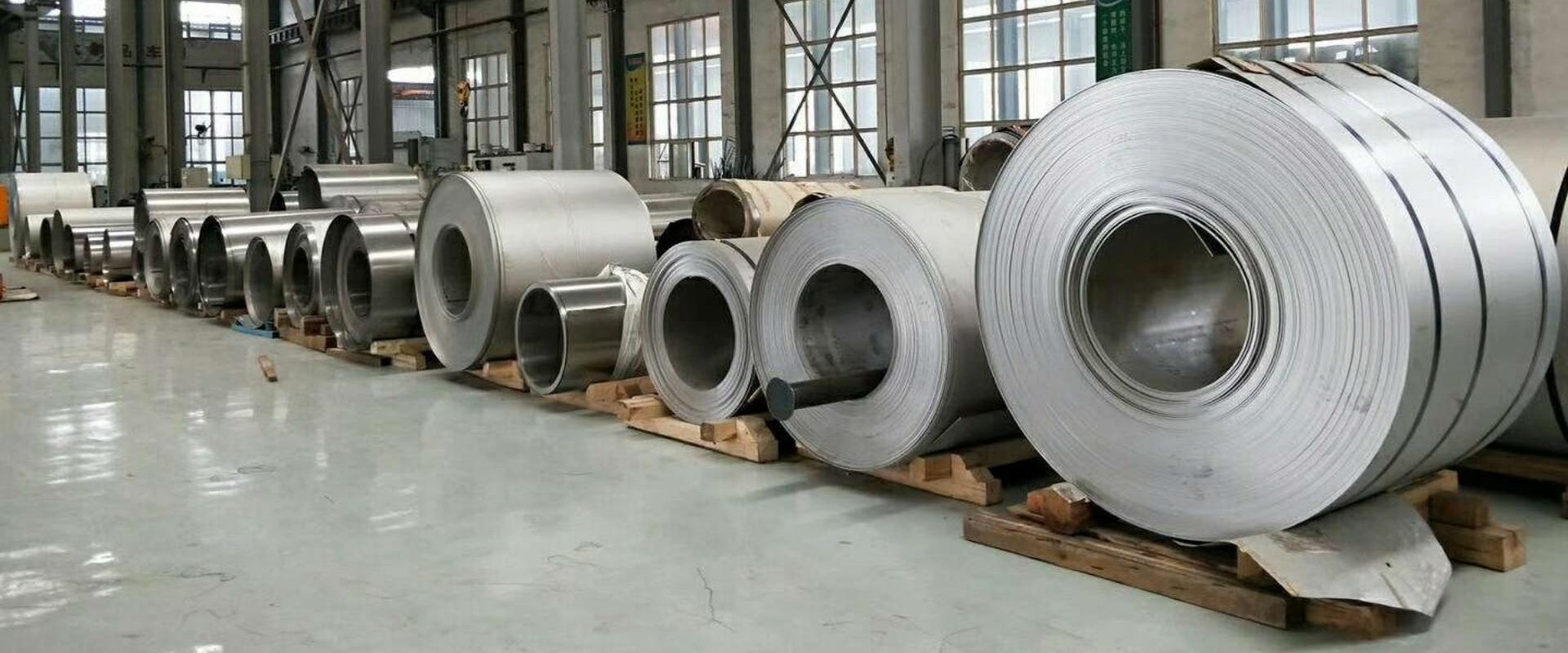
Precision microstructural refinement under computer-controlled thermal zones to guarantee uniform grain size (ASTM 7 to 9).
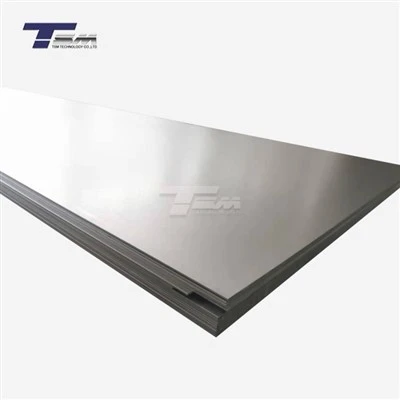
Vacuum furnace operating at 10^-3 Pa to eliminate surface oxidation and alpha-case formation, followed by hydraulic tension leveling.
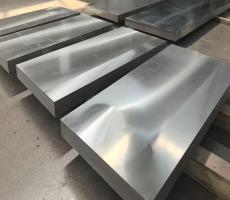
100% C-scan ultrasonic testing according to AMS 2631 to detect micro-voids, inclusions, and internal discontinuities.
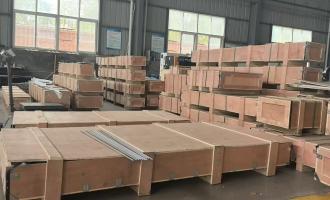
Finished sheet goods packaged in vacuum-sealed protective wrapping and seaworthy wooden cases with full MTC EN 10204 3.1 paperwork.
3.1 Smelting & Vacuum Arc Remelting (VAR)
Quality begins with raw material purity. We utilize 100% virgin titanium sponge combined with high-purity master alloys (Al-V, Zr-Mo). Smelting is performed using double or triple Vacuum Arc Remelting (VAR) to ensure complete chemical homogeneity and total elimination of high-density inclusions (HDI) or low-density interstitial (LDI) defects.
3.2 Controlled Thermal Rolling & Vacuum Annealing
In hot-rolling titanium sheets, controlling temperatures relative to the Beta Transus temperature ($T_\beta \approx 995^\circ\text{C}$ for Ti-6Al-4V) is vital. Rolling below the beta transus creates a fine, equiaxed alpha-beta microstructure yielding optimum fatigue strength. To prevent oxygen embrittlement, stress-relief annealing and vacuum heat treatment are performed in state-of-the-art vacuum furnaces, maintaining surface integrity without brittle alpha-case formation.
3.3 Rigorous Non-Destructive Testing (NDT) & Certification
Every single aerospace sheet manufactured by Almerca Titanium undergoes exhaustive quality verification:
- Ultrasonic Flaw Detection: Immersion C-scan UT per AMS 2631 Class A/AA to verify internal soundness.
- Mechanical Property Testing: Room temperature and elevated temperature tensile tests, bend testing, and hardness verification.
- Chemical Composition Analysis: Direct-reading optical emission spectrometry and gas fusion analysis for interstitial $O_2, N_2, H_2$.
- Microstructure Inspection: Optical metallography verifying equiaxed alpha grains in a transformed beta matrix with zero continuous grain boundary alpha networks.
4. Future Procurement Trends for Aerospace Titanium Sheets (2025–2035)
The global aerospace titanium supply chain is undergoing profound structural shifts driven by commercial aircraft order backlogs, defense modernization, and rising raw material costs. Procurement officers must adapt to the following major industry trends over the coming decade:
4.1 Shift Toward Near-Net-Shape (NNS) Blanks and Precision Waterjet Cutting
Historically, aerospace original equipment manufacturers (OEMs) purchased standard rectangular titanium sheets and machined away up to 80% to 90% of the material. With raw titanium prices fluctuating, tier-1 procurement managers are demanding Near-Net-Shape pre-cut blanks. By utilizing multi-axis CNC abrasive waterjet cutting and laser profiling at the mill level, Almerca Titanium Industry Co., Ltd. delivers custom contoured sheet blanks directly to factory assembly lines. This slashes customer machining times and drastically lowers the overall Buy-to-Fly (BTF) cost ratio.
4.2 Closed-Loop Scrap Recycling & Sustainable "Green Titanium" Procurement
Corporate ESG (Environmental, Social, and Governance) mandates from major aerospace manufacturers are reshaping supplier evaluation criteria. Procurement strategies now heavily weigh closed-loop scrap recycling agreements. Almerca Titanium works closely with global aerospace customers to collect, segregate, clean, and re-smelt turnings and sheet solids under strict AS9100-controlled pathways, reducing carbon footprints while stabilizing raw material supply contracts.
4.3 Supply Chain Diversification & Dual-Sourcing Risk Mitigation
Recent geopolitical volatility exposed the vulnerability of relying on single-region titanium sponge suppliers. Forward-thinking aerospace buyers are establishing dual-sourcing procurement models with qualified Chinese manufacturers who maintain complete vertical integration from sponge processing to finished sheet milling. Almerca Titanium offers long-term supply agreements (LTA), Vendor-Managed Inventory (VMI), and bonded warehouse stocking programs in Europe and North America to guarantee uninterrupted production flow.
4.4 Demand Acceleration Driven by Space Exploration & Defense Hypersonics
Beyond traditional commercial aviation (Boeing 787, Airbus A350), commercial space launch vehicles (SpaceX, Blue Origin, rocket start-ups) and hypersonic defense platforms are driving exponential demand for high-temperature titanium sheets such as Ti-6242 and Ti-6Al-4V ELI. Procurement volumes for thin-gauge cryogenic sheets (0.5mm to 1.5mm) are projected to grow at a CAGR of 12.4% over the next decade.
5. Technological & Metallurgical Development Trends in Aerospace Titanium
As flight speeds increase and aerospace designs push the boundaries of thermodynamic efficiency, titanium sheet technology is evolving along several cutting-edge pathways:
5.1 Superplastic Forming & Diffusion Bonding (SPF/DB) Optimized Sheets
Superplastic forming allows titanium sheet metal to undergo ultra-high elongation (exceeding 500% to 1000%) at elevated temperatures (~900°C) without necking or micro-voiding. Combining SPF with Diffusion Bonding enables engineers to produce hollow, stiffened, complex three-dimensional airframe structures out of single sheet assemblies. Almerca Titanium Industry Co., Ltd. produces specialized ultra-fine grain (UFG) AMS 4911 sheets optimized specifically for SPF/DB processing, ensuring lower forming pressures and faster cycle times.
5.2 Titanium-Graphite (TiGr) Fiber Laminates & Hybrid Structures
Next-generation supersonic commercial transports are researching Titanium-Graphite (TiGr) laminates—alternating layers of ultra-thin titanium sheet (0.25mm) and high-modulus carbon fiber prepreg. TiGr laminates offer higher specific modulus and superior fatigue crack growth resistance compared to monolithic titanium, paving the way for lighter Mach 2+ fuselage skins.
5.3 Cold-Formable High-Strength Beta Titanium Sheets
Traditional Alpha-Beta alloys like Ti-6Al-4V suffer from high springback during cold forming. Metallurgical research is driving the adoption of metastable Beta alloys (such as Ti-15V-3Cr-3Al-3Sn and Ti-5553). These alloys can be cold-formed in the solution-treated condition into complex sheet geometries, then aged to ultra-high tensile strengths exceeding 1250 MPa, revolutionizing high-strength airframe bracketry.
6. Enterprise Advantages of Almerca Titanium Industry Co., Ltd.
When procuring high-value aerospace titanium sheets, selecting a certified, capable, and financially stable manufacturing partner is paramount. Almerca Titanium Industry Co., Ltd. stands out as a world-class global supplier based on core enterprise capabilities:
- 14+ Years of Dedicated Metallurgical Expertise: Founded in 2011 in Shaanxi, China—the epicenter of the national titanium industry—our engineering team possesses over a decade of hands-on experience in high-performance titanium alloy production.
- Fully Integrated Manufacturing Footprint: Spanning 60,000 square meters of production space across 3 specialized mills, housing 100+ sets of advanced equipment including VAR furnaces, reversible rolling mills, vacuum heat treatment lines, and multi-axis CNC cutting centers.
- Massive Monthly Production & Stock Reserves: With a reliable monthly production capacity of 300+ metric tons and extensive raw ingot stocks, we guarantee rapid turnarounds and eliminate supply chain bottlenecks.
- Complete International Standard Compliance: All products strictly conform to AMS, ASTM, ASME, DIN, EN, MIL, and JIS specifications, backed by ISO 9001 and AS9100 quality management systems.
- Uncompromising Traceability & Testing: Every sheet is shipped with fully documented EN 10204 3.1 Mill Test Certificates detailing heat numbers, chemical heats, ultrasonic test results, and mechanical properties. Optional 3rd-party testing via SGS, TÜV, or Bureau Veritas is available on demand.
- Custom Fabrication & Global Logistics: From precision slitting, chemical milling, and waterjet blanking to export-grade vacuum packaging, we deliver door-to-door solutions to over 50 countries worldwide.
7. Frequently Asked Questions (FAQ) for Aerospace Titanium Sheet Procurement
Based on frequent inquiries from global procurement managers, metallurgical engineers, and aerospace supply chain analysts, we have compiled comprehensive answers to key technical questions:
While both specifications cover the chemical composition of Ti-6Al-4V (Grade 5), AMS 4911 is a stringent Aerospace Material Specification. It mandates higher minimum yield strength (828 MPa vs 827 MPa), stricter limits on microstructural grain size (equiaxed alpha phase without continuous grain boundary beta networks), tighter thickness tolerances per AMS 2242, mandatory ultrasonic flaw detection (AMS 2631), and controlled thermal processing history to prevent beta-transus overheating. ASTM B265 Grade 5 is intended for general industrial and chemical applications and does not enforce aerospace-level NDT or microstructural guarantees.
Alpha-case is an extremely brittle, oxygen-enriched surface layer that forms when titanium is exposed to oxygen at elevated temperatures. It severely compromises fatigue life and promotes surface micro-cracking. Almerca Titanium Industry Co., Ltd. prevents alpha-case by using high-vacuum annealing furnaces ($10^{-3}\text{ Pa}$) and protective inert gas environments. Any residual oxygen pick-up during hot rolling is completely removed via precision chemical milling and controlled hydrofluoric/nitric acid (HF/$HNO_3$) pickling baths, verified through metallographic cross-sectioning under 1000x magnification.
Almerca Titanium supplies sheets ranging from 0.5mm (0.020 in) up to 6.0mm (0.250 in) in thickness (thicker dimensions classified as plate). Thickness tolerances strictly comply with AMS 2242 (e.g., $\pm 0.04\text{ mm}$ on thin gauge sheets). Standard surface finishes include:
• Descaled & Pickled (Standard Mill Finish): Uniform silver-gray matte surface.
• Chemically Milled Finish: Smooth, etch-cleaned surface optimized for structural bonding.
• Bright Cold-Rolled Finish: Smooth, low-friction surface ($R_a \le 0.8\text{ }\mu\text{m}$).
• Precision Polished: Surface roughness refined down to $R_a \le 0.4\text{ }\mu\text{m}$ upon request.
For cold forming annealed AMS 4911 Ti-6Al-4V titanium sheet, the minimum recommended bend radius is 4.5t to 5.0t (where t is the sheet thickness) when forming perpendicular to the rolling direction, and 5.5t to 6.0t parallel to the rolling direction. To achieve tight radius bends (down to 1.5t to 2.0t) without cracking or elastic springback, warm brake forming or hot forming at temperatures between 600°C and 700°C (1110°F to 1300°F) is strongly recommended.
The Buy-to-Fly (BTF) ratio measures the weight of raw titanium purchased versus the final weight incorporated into the aircraft frame. In complex sheet structural assemblies, BTF ratios can exceed 8:1, meaning 87.5% of purchased metal is machined away as scrap. Almerca Titanium helps buyers dramatically lower overall program costs by offering precision waterjet contouring, laser-cut custom blanks, tight thickness tolerances, and chemical pre-milling—reducing raw material purchasing costs by up to 25% for tier-1 aerospace programs.
Yes. In addition to our internal AS9100 quality control documentation and standard EN 10204 3.1 Mill Test Certificates, we regularly collaborate with globally recognized third-party inspection agencies including SGS, TÜV Rheinland, Bureau Veritas (BV), and Lloyd's Register. Customers may request independent sampling, chemical re-verification, ultrasonic C-scan witnessing, and room/elevated-temperature tensile testing prior to dispatch.
Standard stocked sheet dimensions (1000x2000mm, 1220x2440mm / 4x8 ft in AMS 4911 Grade 5) ship within 3 to 7 business days. Custom mill rolling runs, specialized heat-treated tempers, or custom cut-to-size blanks typically require 15 to 25 calendar days. We export globally via air freight (for urgent aerospace AOG situations), ocean container freight (FCL/LCL), and express courier services, with all products packaged in heavy-duty, vacuum-sealed seaworthy wooden crates lined with moisture-proof barriers.
Grade 23 ELI limits interstitial elements (Oxygen ≤ 0.13%, Nitrogen ≤ 0.03%, Iron ≤ 0.25%). This chemical refinement prevents interstitial atoms from pinning dislocations at ultra-low temperatures. Consequently, while standard Grade 5 can become susceptible to embrittlement near liquid nitrogen/hydrogen temperatures (-196°C to -253°C), Grade 23 ELI maintains exceptional notch toughness, high fracture toughness ($K_{Ic}$), and structural ductility, making it indispensable for orbital launch vehicle tankage and rocket engine cryo-valves.
Request an Instant Quotation & Technical Consultation
Looking for certified Aerospace Titanium Sheets (AMS 4911, AMS 4907, AMS 4919) with full material traceability and competitive factory-direct pricing? Speak directly with our senior metallurgical engineering and sales team today.