Titanium Industry
Blog & Technical Insights
Discover technical guides, industry trends, and material innovation insights from Almerca Titanium Industry Co., Ltd.
Material Engineering &
Application Standards
Comprehensive updates on ASTM, ASME, and ISO standards for global titanium procurement.
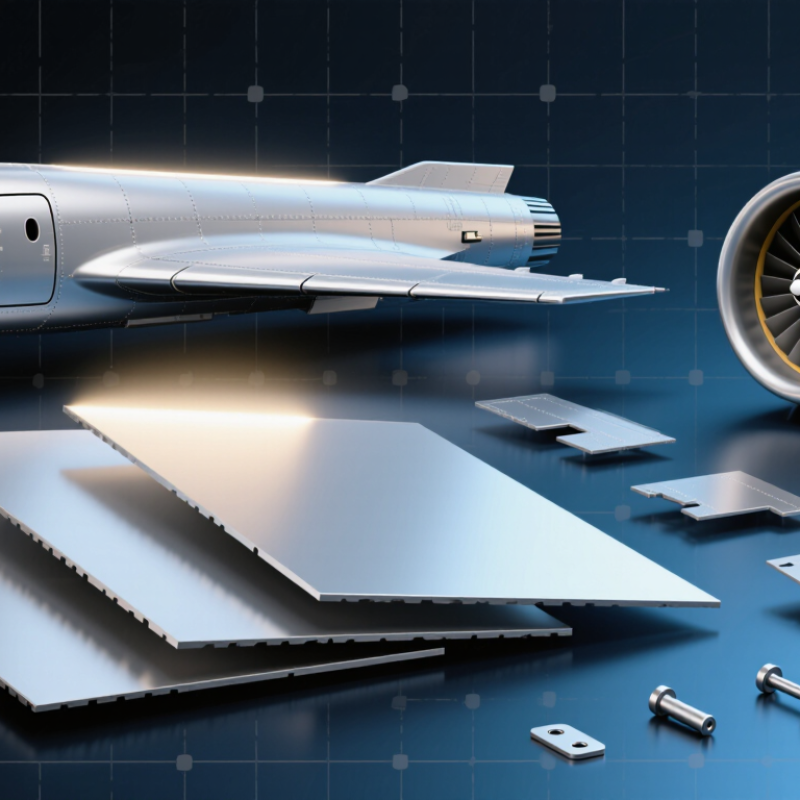
Aerospace Titanium Sheets are thin, engineered metal products used where strength, weight, and durability must work together. They appear in aircraft skins, wing structures, engine components, fasteners, and selected spacecraft assemblies. Their silver surface may look ordinary, but the material carries demanding responsibilities at altitude.
Matthew J. Donachie Jr., author of Titanium: A Technical Guide, wrote, “Titanium alloys combine high strength with low density and excellent corrosion resistance.” This principle explains their continuing value in aerospace manufacturing. Titanium can reduce structural weight while maintaining dependable performance under vibration, temperature changes, and repeated loading. It also resists corrosion better than many conventional structural metals.
Yet Aerospace Titanium Sheets are not automatically the best choice. Grade selection matters. Thickness, alloy condition, surface finish, forming limits, and joining methods can change the final result. A sheet that performs well in a fuselage panel may be unsuitable for a hot engine area. That detail is easy to overlook.
Manufacturers typically evaluate tensile strength, elongation, fatigue behavior, dimensional accuracy, and traceability. Aerospace buyers also require controlled processing and documented inspection. Small defects can become serious during long service periods.
The material is impressive.
Still, titanium has weaknesses. It costs more than aluminum, requires careful machining, and can react poorly with certain metals without proper isolation. Therefore, understanding Aerospace Titanium Sheets means examining both their advantages and their limits. This article introduces their grades, properties, applications, manufacturing processes, and selection considerations. Some explanations remain simplified, because real aerospace specifications depend on design authority, operating conditions, and applicable standards.
Definition and Key Characteristics of Aerospace Titanium Sheet
What Is Aerospace Titanium Sheet?
Aerospace titanium sheet is a flat, rolled titanium product made for aircraft and spacecraft structures. It combines low density with high mechanical strength, making it useful where every kilogram matters. Engineers commonly select it for skins, brackets, bulkheads, engine-area components, and other load-bearing parts.
Its key characteristic is an excellent strength-to-weight ratio. Titanium sheet also resists corrosion, including damage from moisture and many aerospace fluids. A stable oxide layer forms naturally on its surface and helps protect the metal. It keeps useful strength at elevated temperatures, although its performance depends on the alloy and service environment. Grade selection matters.
Not all titanium sheet performs the same way. Some grades offer better weldability, while others provide higher strength or improved heat resistance. Thickness, rolling direction, surface condition, and heat treatment can affect forming results. In practical fabrication, careful control prevents edge cracking, contamination, and unwanted distortion. Clean tools are essential. Small defects matter.
Aerospace material is normally verified through chemical analysis, mechanical testing, dimensional checks, and traceable documentation. Specifications may also control flatness, surface finish, and ultrasonic quality. These records help engineers confirm that each sheet matches the design requirements. Titanium is often described as easy to trust, but that assumption needs caution. Poor handling or unsuitable joining methods can reduce its reliability. A qualified review remains necessary for every application.
What Is Aerospace Titanium Sheet? - Definition and Key Characteristics of Aerospace Titanium Sheet
| Data Dimension | Definition or Typical Value | Why It Matters in Aerospace Applications |
|---|---|---|
| Definition | Flat-rolled titanium material supplied as sheet, generally thinner than plate and manufactured to aerospace material specifications. | Provides a lightweight, corrosion-resistant material for formed, machined, and structural aircraft components. |
| Common Aerospace Grades | Commercially pure Grade 1 and Grade 2; alpha-beta Grade 5 (Ti-6Al-4V); and Grade 23 (Ti-6Al-4V ELI). | Different grades balance formability, strength, fracture toughness, weldability, and low-temperature performance. |
| Typical Sheet Thickness | Approximately 0.010–0.250 in (0.25–6.35 mm), depending on the grade, specification, product form, and application. | Thin gauges support skins and diaphragms, while heavier gauges are used for brackets, covers, and formed structural details. |
| Density | Approximately 4.43 g/cm³ for Ti-6Al-4V at room temperature. | Titanium is about 40% lighter than steel, helping reduce aircraft component mass while retaining high strength. |
| Elastic Modulus | Approximately 114 GPa (16.5 million psi) for Ti-6Al-4V. | The lower modulus compared with steel allows greater elastic deflection and must be considered in stiffness-sensitive designs. |
| Tensile Strength | Typically about 895 MPa (130 ksi) minimum for annealed Grade 5 sheet, with actual values depending on specification and heat treatment. | Offers high load-carrying capability at a relatively low weight. |
| Yield Strength | Typically about 825 MPa (120 ksi) minimum for annealed Grade 5 sheet, subject to product specification and testing direction. | Supports resistance to permanent deformation in highly loaded aerospace parts. |
| Strength-to-Weight Ratio | High; titanium alloys provide a favorable combination of strength and low density compared with many conventional structural metals. | Useful for weight reduction in airframes, engine components, and aerospace systems where performance and mass are critical. |
| Temperature Capability | Grade 5 is commonly used for continuous service temperatures around 315°C (600°F), although allowable limits depend on design and specification. | Retains useful mechanical properties in moderately elevated-temperature environments without the density of nickel-based alloys. |
| Melting Range | Approximately 1,600–1,660°C (2,912–3,020°F) for Ti-6Al-4V. | Indicates the high-temperature processing range and the need for controlled manufacturing conditions. |
| Corrosion Resistance | Excellent resistance in air, seawater, and many chloride-containing environments due to a stable, self-healing titanium-oxide layer. | Reduces corrosion-related maintenance and supports use in aircraft structures, hydraulic areas, and marine aerospace environments. |
| Fatigue Performance | Generally strong fatigue performance when the surface condition, notch sensitivity, residual stress, and manufacturing quality are controlled. | Important for components exposed to repeated pressurization, vibration, engine loads, and cyclic flight stresses. |
| Fracture Toughness | Grade 23, also known as Ti-6Al-4V ELI, provides improved ductility and fracture toughness compared with standard Grade 5 in many product forms. | Suitable for safety-critical components where crack growth resistance and damage tolerance are essential. |
| Formability | Commercially pure grades generally form more easily than Grade 5; Grade 5 sheet often requires controlled temperature, tooling, and bend-radius practices. | Material selection and forming methods directly affect springback, cracking risk, and dimensional accuracy. |
| Weldability | Good when welding is performed with suitable shielding from oxygen, nitrogen, hydrogen, and moisture. | Proper shielding prevents embrittlement, discoloration, contamination, and loss of mechanical performance in welded assemblies. |
| Thermal Conductivity | Approximately 6.7 W/m·K for Ti-6Al-4V at room temperature. | Low thermal conductivity can increase localized heat during cutting, drilling, and machining, requiring appropriate tooling and cooling control. |
| Thermal Expansion | Approximately 8.6 × 10⁻⁶/°C for Ti-6Al-4V near room temperature. | Its relatively low expansion helps limit thermal distortion and can support compatibility with selected titanium components. |
| Surface Appearance | Common finishes include mill finish, descaled finish, pickled finish, and polished or mechanically finished surfaces. | Surface condition affects fatigue life, corrosion behavior, inspection results, and suitability for forming or bonding. |
| Typical Aerospace Uses | Aircraft skins, bulkheads, brackets, clips, fairings, engine parts, firewalls, ducts, fastener areas, and structural reinforcement components. | These applications benefit from titanium sheet's combination of low density, strength, corrosion resistance, and temperature capability. |
| Quality and Traceability | Typical aerospace supply requirements include certified chemical composition, mechanical test results, heat or lot traceability, dimensional inspection, and approved material specifications. | Traceability supports design compliance, airworthiness documentation, manufacturing control, and lifecycle maintenance. |
Values shown are typical reference data. Exact properties, thickness ranges, tolerances, and allowable applications depend on the titanium grade, product specification, heat treatment, manufacturing route, and aerospace design requirements.
FAQS
It combines low density, high strength, and strong corrosion resistance. This can reduce structural weight. The best grade still depends on the part’s thickness, loads, and forming method.
Grade 2 is often a practical choice for formed sheet and lighter structural parts. It balances strength, ductility, and corrosion resistance. That balance is useful, but not universal.
Grade 5 provides higher strength for skins, brackets, fittings, and airframe components. Its strength-to-weight ratio is impressive. Tight-radius forming may still cause problems.
Grade 23 contains lower interstitial elements than standard Grade 5. This can improve fracture toughness and damage tolerance. It suits more critical applications where cracking consequences are serious.
Ti-5Al-2.5Sn can be considered for elevated-temperature applications. Some alpha-beta and beta alloys support heavily loaded components. Their processing requirements are less forgiving.
No. A simple ranking can mislead. Performance also depends on thickness, rolling direction, heat treatment, surface condition, and forming method. Strength alone is not enough.
Production begins with melting and vacuum-controlled refining. The ingot is hot rolled, trimmed, and repeatedly annealed. Cold rolling can improve thickness control. Pickling removes oxide scale.
Technicians check chemistry, grain structure, tensile strength, elongation, and thickness. Ultrasonic testing can reveal internal discontinuities. Dye penetrant testing can detect surface-breaking cracks. Visual inspection alone is insufficient.
Records connect the sheet to its chemistry, rolling history, heat treatment, and inspections. An incomplete rolling history weakens confidence. A bright surface can still hide defects.
They should review material specifications, mechanical data, weldability, inspection requirements, and lot records. They should also check the intended forming radius. Small details matter.
Conclusion
Aerospace Titanium Sheets are thin, high-performance metal materials designed for demanding aircraft and spacecraft environments. They combine low density with exceptional strength, corrosion resistance, fatigue performance, and stability across a wide range of temperatures. Common grades include commercially pure titanium for corrosion-sensitive components and alloyed grades that provide greater strength for structural and engine-related applications. Selection depends on load requirements, temperature exposure, forming needs, and compatibility with surrounding materials.
Production typically involves melting, rolling, heat treatment, surface preparation, and precision inspection. Important quality controls may include chemical composition checks, dimensional measurement, mechanical testing, and nondestructive examination to ensure reliable performance. In aerospace systems, these sheets can be used for skins, ducts, brackets, shielding, panels, and spacecraft structural or thermal-control components. However, titanium can be costly, difficult to machine, and vulnerable to contamination or galvanic interaction with dissimilar metals. Proper storage, clean handling, scheduled inspections, and controlled repair practices are therefore essential for maintaining service life and safety.