Titanium Industry
Blog & Technical Insights
Discover technical guides, industry trends, and material innovation insights from Almerca Titanium Industry Co., Ltd.
Material Engineering &
Application Standards
Comprehensive updates on ASTM, ASME, and ISO standards for global titanium procurement.
What Are the Top Titanium Square Tube Types in 2026?
Table of Contents
- How Titanium Square Tubes Are Classified by Grade and Composition
- Commercially Pure Titanium Square Tubes and Their Key Grades
- Titanium Alloy Square Tubes for Strength and Heat Resistance
- Seamless and Welded Titanium Square Tubes by Manufacturing Method
- Choosing a Titanium Square Tube Type for Its Intended Application
- FAQS
- Conclusion
- Related Posts
In 2026, choosing a Titanium Square Tube means looking beyond the alloy name. Grade, manufacturing route, wall thickness, and service conditions all shape performance. Matthew J. Donachie, author of Titanium: A Technical Guide, provides a useful materials-selection perspective. Paraphrased from his technical guidance: “A grade name is only the start; service conditions determine whether titanium is worth its cost.” This is a paraphrase, not a verified verbatim quotation.
This guide compares common options, including commercially pure Grade 2, stronger Grade 5 (Ti-6Al-4V), and Grade 9 (Ti-3Al-2.5V). It also considers welded and seamless tubes, since production method can affect availability, dimensions, and inspection needs. A clean cut edge and consistent wall thickness matter. So does a clear material certificate. Short version: check the details.
The “top” type depends on the job. Grade 2 may suit corrosion-focused applications, while Grade 5 offers higher strength but can bring greater cost and fabrication demands. Grade 9 can be a useful middle ground, though stock sizes vary by supplier. These are practical starting points, not universal recommendations. A design exposed to heat, cyclic loading, or aggressive chemicals needs engineering review and verified specifications. Even a promising catalog listing may not match the actual service environment. That part is easy to overlook.
How Titanium Square Tubes Are Classified by Grade and Composition
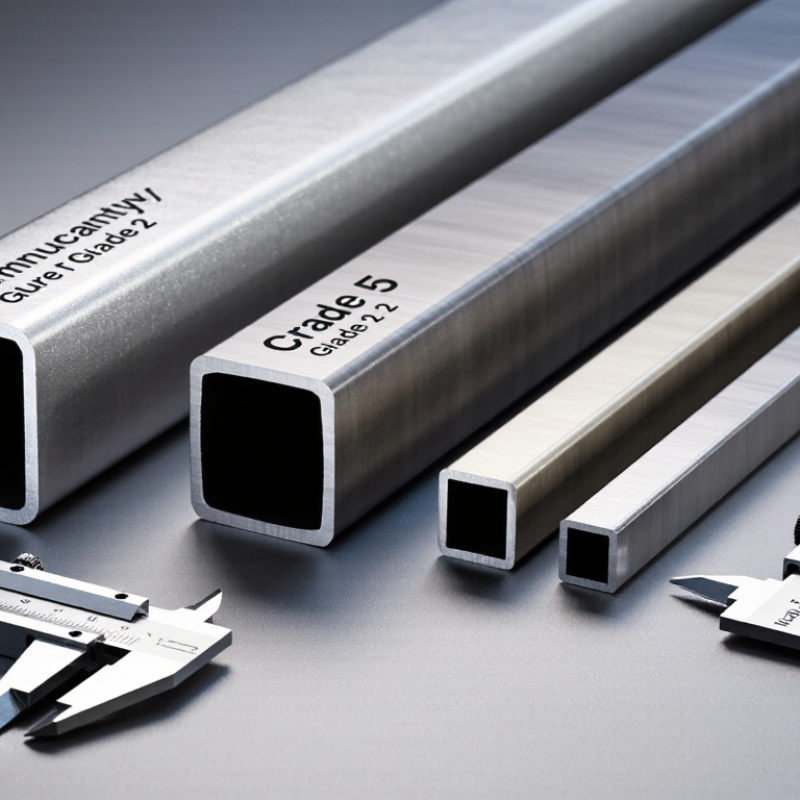
Titanium square tubes are commonly classified by grade, which reflects their chemistry and expected mechanical behavior. Commercially pure Grades 1 through 4 contain mostly titanium, with controlled amounts of oxygen and other elements. As oxygen content generally increases across these grades, strength rises while ductility tends to decrease. Grade 1 bends readily; Grade 4 offers higher strength. Small differences matter.
For demanding applications, alloy grades add elements to tune performance. Grade 5, Ti-6Al-4V, combines aluminum and vanadium for high strength and heat resistance. Grade 9, Ti-3Al-2.5V, is often selected where a balance of strength and formability is useful. The best choice depends on service loads, temperature, fabrication method, and corrosion exposure—not just the grade number.
The square shape does not define the composition. Two tubes with identical dimensions may behave differently if their grades, wall thicknesses, or heat treatments differ. Check the material certificate for grade and chemical analysis, then compare it with the relevant product specification. A neat grade chart can be misleading; actual chemistry and tube condition deserve attention. Weld quality and dimensional tolerances matter, too.
Commercially Pure Titanium Square Tubes and Their Key Grades
What Are the Top Titanium Square Tube Types in 2026?
Commercially Pure Titanium Square Tubes and Their Key Grades
Commercially pure (CP) titanium square tubes are selected for corrosion resistance, formability, and dependable strength. Grades 1 through 4 differ mainly in oxygen content and mechanical performance. Higher grades generally provide greater strength, but less ductility. Grade 1 suits parts needing easier forming; Grade 2 is a common general-purpose choice. Think wet process equipment, lightweight frames, and tubing exposed to salty spray.
ASTM B861 and B862 specify mechanical requirements for titanium pipe and welded tubing. Their grade tables set minimum tensile strengths of about 240 MPa for Grade 1, 345 MPa for Grade 2, 450 MPa for Grade 3, and 550 MPa for Grade 4. Grade 2’s minimum yield strength is about 275 MPa. These figures help compare grades, but they do not replace checking the exact product specification, dimensions, or certification. Square sections may be formed or welded, so manufacturing route matters.
Check the mill test certificate. For a square tube, also confirm wall thickness, corner radius, and weld quality; these details affect fabrication and service performance. Grade 4 can be attractive where higher strength matters, yet forming it may take more effort. That trade-off is easy to underestimate. ASTM pipe and tube values are useful reference points, but buyers should confirm that the supplier’s documented standard covers the finished square section.
Titanium Alloy Square Tubes for Strength and Heat Resistance
What Are the Top Titanium Square Tube Types in 2026?
Titanium Alloy Square Tubes for Strength and Heat Resistance
Titanium square tubes are selected by alloy, manufacturing route, and operating temperature. Grade 2 commercially pure titanium offers useful corrosion resistance and formability. Grade 5, Ti-6Al-4V, is the stronger choice for structural loads. ASM International’s Titanium: A Technical Guide lists its density at about 4.43 g/cm³, with strength varying by product condition. That balance helps reduce frame weight without making the section feel flimsy. Still, square tubing is often custom-formed, so properties can differ from standard round-pipe data.
Heat changes the choice. Ti-6Al-4V is generally used for sustained service around 400°C or below; titanium alloys designed for elevated-temperature service can reach higher operating ranges. The exact limit depends on stress, atmosphere, and exposure time. ASTM B861 and B862 cover seamless and welded titanium pipe, respectively, but do not automatically qualify every square tube. Check the tube’s material certificate, weld procedure, wall thickness, and temperature rating. A neat-looking corner is not proof of uniform strength.
Tips: Ask for alloy and heat-treatment records. Measure wall thickness at the corners, not just the flat faces. For hot service, test a representative joint under load. It is easy to overestimate heat resistance; I would verify the actual duty cycle before specifying the alloy.
Seamless and Welded Titanium Square Tubes by Manufacturing Method
In 2026, titanium square tubes are commonly selected as seamless or welded products, a distinction rooted in how each section is made. Manufacturing method shapes consistency, cost, and the checks buyers should request. Seamless tube starts as a solid billet, which is pierced and formed into a hollow square section. This avoids a longitudinal weld seam. It can suit demanding pressure or fatigue service, but wall thickness and corner geometry still need verification. Seamless is not flawless.
Welded square tube is formed from titanium sheet or strip, then joined along one seam before sizing and finishing. It often offers predictable dimensions and can be economical for frames, equipment supports, and architectural assemblies. Look closely at seam quality, heat-affected areas, surface condition, and dimensional tolerances. Details matter. Request material certificates, the manufacturing route, and inspection records, then match them to the design load and environment. Corrosion resistance depends on grade, surface finish, and exposure, not the product label alone. Square corners can concentrate stress. Discuss corner radius and testing requirements before ordering; I would not assume two tubes with identical dimensions perform alike.
What Are the Top Titanium Square Tube Types in 2026?
Typical manufacturing-route operations for seamless and welded titanium square tubes
This simplified comparison shows whether an operation is typically part of each route. Seamless tubes are formed from a solid billet without a weld seam; welded tubes are formed from strip or sheet and joined at a seam. Actual production sequences vary by product and manufacturer.
Choosing a Titanium Square Tube Type for Its Intended Application
Choosing a titanium square tube begins with the job it must perform, not just its shape. Grade 2, a commercially pure titanium, is often considered where corrosion resistance and easier forming matter. Grade 5 offers greater strength for weight-sensitive parts, but forming and machining may be more demanding. Neither grade is automatically best. Check the required strength, environment, and material certification before specifying it.
For frames, brackets, or equipment exposed to moisture, compare wall thickness, outer dimensions, and corner geometry. A thin wall can save weight, yet may dent or buckle under concentrated loads. In fabrication, fit-up matters: confirm dimensional tolerances and discuss welding requirements with the tube supplier. Seamless and welded options may differ in availability, cost, and suitability for the design. Do not assume one construction method fits every service condition.
Think about the complete assembly. Will the tube be cut, drilled, bent, or joined to another metal? Those details can affect the grade and finish you choose. For a load-bearing part, have the design checked against actual forces and operating conditions; a material name alone does not guarantee safe performance. The choice can feel less tidy than a catalog table suggests. That is worth acknowledging. A clear drawing, realistic tolerances, and verified material data make selection more reliable.
FAQS
Grades 1 through 4 mainly differ in oxygen content and mechanical performance. Strength generally rises by grade, while ductility falls. Grade 1 is easier to form; Grade 2 is a common general-purpose option.
Approximate minimum tensile strengths are 240 MPa for Grade 1, 345 MPa for Grade 2, 450 MPa for Grade 3, and 550 MPa for Grade 4. Verify the finished tube’s specification and certification.
Seamless tube has no longitudinal weld seam and may suit demanding pressure or fatigue service. Still, check wall thickness and corner geometry. Seamless is not flawless.
Check seam quality, heat-affected areas, surface condition, and dimensional tolerances. Ask for manufacturing details and inspection records. Details matter.
Grade 2 is often considered for corrosion resistance and easier forming. Compare wall thickness, dimensions, and corner shape against the loads and environment. No grade is automatically best.
Review the material certificate, wall thickness, corner radius, weld quality, and applicable product standard. Confirm that the documentation covers the finished square section. Check twice.
A thinner wall can reduce weight, but may dent or buckle under concentrated loads. Match it to actual forces and service conditions. Not always.
Consider whether the tube will be cut, drilled, bent, or joined to another metal. Confirm tolerances and welding requirements with the supplier. A catalog table feels tidy; real assemblies are less tidy.
Conclusion
This guide explains how Titanium Square Tube options are classified by grade, composition, and manufacturing method. It compares commercially pure titanium grades, which are valued for corrosion resistance and formability, with titanium alloys designed to provide greater strength or withstand elevated temperatures. Understanding these differences helps clarify how material properties influence a tube’s performance in demanding environments.
The article also explores seamless and welded Titanium Square Tube products, outlining how their production methods can affect consistency, dimensions, and suitability for specific uses. It concludes with practical considerations for selecting a tube type, including required strength, heat exposure, corrosion conditions, fabrication needs, and intended application. By weighing these factors together, readers can identify a suitable titanium square tube for their project without treating any single grade or construction method as the best choice for every situation.

Blog Tags: