Titanium Industry
Blog & Technical Insights
Discover technical guides, industry trends, and material innovation insights from Almerca Titanium Industry Co., Ltd.
Material Engineering &
Application Standards
Comprehensive updates on ASTM, ASME, and ISO standards for global titanium procurement.
2026 Top Titanium CNC Machined Parts Suppliers?
Table of Contents
- Titanium CNC Machining Basics: Grades, Properties, and ASTM Standards
- Supplier Evaluation Using ISO 9001, AS9100, and 2026 Quality Metrics
- Comparing CNC Accuracy, Tolerances, Lead Times, and Production Capacity
- Reviewing 2026 Titanium Parts Suppliers by Industry Certifications
- Selecting Suppliers Through Cost, MOQ, Surface Finish, and Testing Data
- FAQS
- Conclusion
- Related Posts
Choosing the right supplier for Titanium CNC Machined Parts requires more than comparing hourly machining rates. Titanium combines low density, high strength, corrosion resistance, and difficult cutting behavior. These qualities make supplier capability especially important for aerospace, medical, energy, and high-performance industrial applications.
Industry demand supports this focus. Grand View Research identifies aerospace, defense, medical, and chemical processing as major titanium-consuming sectors. Its titanium market analysis also indicates continued growth through the decade. MarketsandMarkets reports strong expansion in the CNC machine market, driven by automation, multi-axis machining, and connected production systems. These reports show opportunity. They do not prove that every listed supplier can deliver reliable parts.
That distinction matters.
This 2026 guide evaluates leading suppliers through practical manufacturing evidence. Key factors include titanium grade control, five-axis capacity, tooling strategy, surface-finish consistency, and inspection equipment. A capable supplier should provide material certificates, batch traceability, dimensional reports, and clear nonconformance procedures. Look for CMM inspection, first-article inspection experience, and documented process controls. ISO 9001 certification is useful. AS9100 or ISO 13485 may matter more for regulated applications.
Real production details reveal more than polished websites. Ask how a supplier manages heat during cutting, thin-wall distortion, burr removal, and chip evacuation. Request sample reports, tolerance examples, and references for similar components. A perfect ranking is impossible. Public information is often incomplete, and supplier performance can change after equipment, staff, or ownership changes. Treat this list as a qualified starting point, not a final purchasing decision. Verify capabilities directly before approving prototypes, production orders, or critical applications.
Titanium CNC Machining Basics: Grades, Properties, and ASTM Standards
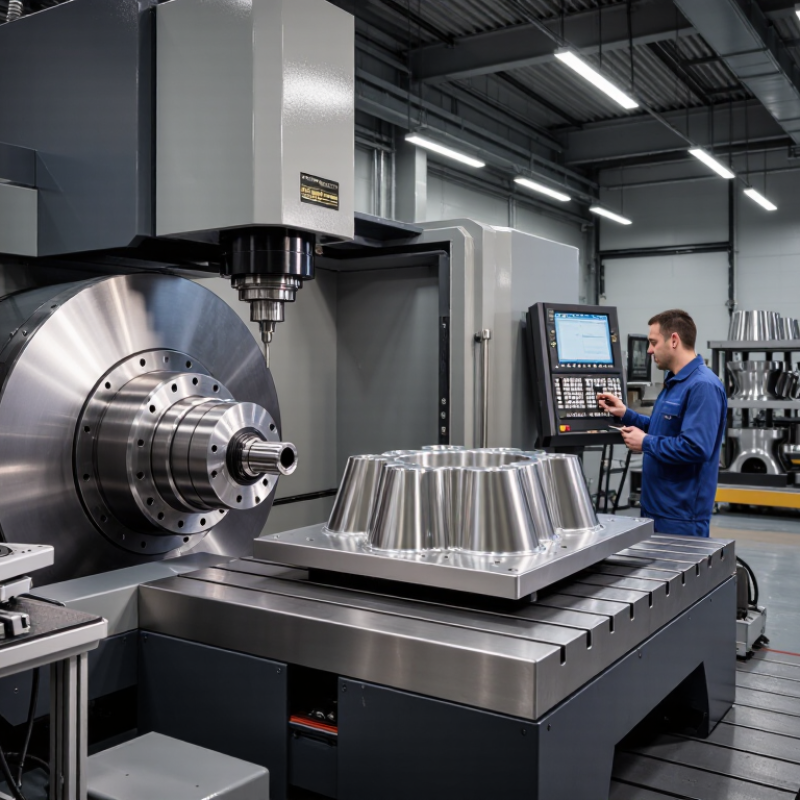
Titanium CNC machining begins with the grade, not the cutting tool. Commercially pure Grades 1 to 4 offer increasing strength and useful corrosion resistance. Grade 5, commonly called Ti-6Al-4V, provides a strong balance of strength, weight, and temperature performance. Grade 23 offers improved ductility and fracture toughness for demanding applications.
Titanium conducts heat poorly. Heat stays near the cutting edge, so excessive speed can quickly damage the tool. Sharp carbide tools, rigid workholding, steady coolant, and controlled feed rates reduce built-up edges and work hardening. Avoid rubbing. It often creates more trouble than cutting. Thin walls may spring back after machining, especially when clamping pressure is uneven. A trial component can reveal this problem earlier than a drawing review.
ASTM standards help confirm material identity and delivery requirements. ASTM B265 covers titanium strip, sheet, and plate. ASTM B348 addresses bars and billets. ASTM B381 applies to titanium forgings, while ASTM B367 covers castings. These standards may define chemistry, mechanical properties, dimensions, and testing. They do not automatically guarantee excellent CNC results. A reliable supplier should provide heat numbers, certificates, grade verification, and inspection records. Ask how the material was stored and traced. That detail is easy to overlook. Supplier comparisons for 2026 should also examine tolerance control, surface finish data, and experience with thin sections. One weakness remains: published capability claims can sound precise, but actual results depend on geometry, batch condition, and inspection method.
2026 Top Titanium CNC Machined Parts Suppliers? — Titanium CNC Machining Basics: Grades, Properties, and ASTM Standards
This chart compares representative minimum tensile-strength requirements for commonly machined titanium grades. Commercially pure Grade 2 offers good corrosion resistance and formability, while Grade 5 provides substantially higher strength. Grade 23 is an extra-low-interstitial Ti-6Al-4V grade commonly selected for demanding medical and aerospace applications. Values are based on commonly referenced ASTM product specifications, including ASTM B348, ASTM B265, ASTM B381, and ASTM F136; actual requirements may vary by product form, heat treatment, and specification edition.
Supplier Evaluation Using ISO 9001, AS9100, and 2026 Quality Metrics
2026 Top Titanium CNC Machined Parts Suppliers?
Supplier evaluation should begin with verified systems, not polished websites. ISO Survey 2023 recorded 1,265,216 ISO 9001 certificates worldwide. That number shows certification is common, but it does not prove titanium expertise. Ask for the current certificate, scope, audit status, and corrective-action records.
AS9100 certification adds aerospace-focused controls, including risk management, traceability, and configuration control. A capable supplier should provide material certificates, heat-lot tracking, first article inspection reports, and calibrated inspection records. For titanium parts, review tool-life monitoring and contamination controls. Iron transfer can create serious surface risks. Useful 2026 metrics include first-pass yield above 98%, nonconformance rates below 1%, and on-time delivery above 95%. These figures should be measured over at least six months. A single impressive month proves little.
Tips: Request three recent anonymized inspection reports. Check dimensional results, not only pass labels. Confirm CMM uncertainty and calibration dates. Ask how the supplier handles a failed feature. A strong answer includes containment, root-cause analysis, and preventive action. Aerospace quality guidance from the IAQG supports this evidence-based approach. Deloitte’s 2024 aerospace outlook also highlights resilient supply chains and digital quality visibility. However, supplier scorecards can hide rework. I would track rework hours separately. That omission is easy to miss. Titanium machining is rarely cheap, and rushed approval can make small defects expensive.
Comparing CNC Accuracy, Tolerances, Lead Times, and Production Capacity
Selecting a top titanium CNC machined parts supplier requires more than a polished capability chart. Ask for measured evidence. ISO 230-2 defines tests for positioning accuracy and repeatability, while ISO 2768 offers only general tolerances. It is not a substitute for drawing-specific control.
A practical audit should compare CMM reports, first-article results, and tool-wear records. Titanium magnifies small process weaknesses. Heat, cutting-force changes, and springback can shift thin walls after machining. For critical features, request actual capability data, not a machine’s advertised resolution. A process capability index above 1.33 is commonly targeted for stable production, although customer specifications may demand more. The 2023 aerospace manufacturing outlook from Deloitte also identifies skilled-labor shortages as a continuing production risk. Operator experience still matters.
Lead time needs equal scrutiny. Compare quoted days with material certification, programming, inspection, and finishing included. The 2024 Manufacturing Outlook survey by the National Association of Manufacturers reported persistent supply-chain and workforce pressure, both of which can extend delivery promises. Ask for monthly titanium capacity, current utilization, backup machines, and inspection throughput. Capacity is not the same as availability. I have seen impressive tolerances fail during volume production. That deserves honest review.
Reviewing 2026 Titanium Parts Suppliers by Industry Certifications
2026 Top Titanium CNC Machined Parts Suppliers?
In 2026, certification should be a practical screening tool for titanium CNC suppliers. ISO 9001 indicates controlled quality processes, but it does not prove machining expertise. Aerospace projects may require AS9100, material traceability, and documented first-article inspection. Medical components often need ISO 13485 and strict contamination controls. Automotive programs may favor IATF 16949, especially for repeat production.
Ask suppliers for current certificates, accreditation details, and defined scopes. A certificate limited to sales activities is not enough. Check the issuing body, expiration date, site address, and covered processes. Reliable suppliers should also provide heat-lot records, inspection reports, calibration evidence, and certificates of conformity. These documents connect the titanium bar to the finished component.
Shop-floor experience still matters. Titanium can generate heat, gall tools, and expose weak fixturing. Look for measured cutting parameters, controlled coolant delivery, and inspection of thin walls or deep pockets. A capable supplier should explain how it manages distortion, burrs, and surface damage. Certification alone is an imperfect filter. I would also request sample reports and ask how nonconforming parts are handled. Some suppliers communicate beautifully but reveal little technical evidence. That is a warning. A smaller certified facility may still outperform a larger one when its records are precise, its operators are experienced, and its inspection equipment matches the tolerance requirements.
| Review Dimension | Certification or Standard | Applicable Industry | What It Demonstrates | Relevance to Titanium CNC Machining | Evidence to Request from a Supplier | Selection Priority |
|---|---|---|---|---|---|---|
| Quality management | ISO 9001:2015 | General manufacturing and engineering | A documented quality-management system covering process control, corrective action, risk-based thinking and continual improvement. | Supports repeatable inspection, revision control and traceability for titanium components. | Valid certificate, accreditation body, certificate scope, site address and expiry date. | High |
| Aerospace quality | AS9100D | Aerospace and defense | An aerospace quality-management standard based on ISO 9001 with additional requirements for product safety, configuration management, counterfeit-part prevention and operational risk. | Useful when parts require strict documentation, controlled changes and aerospace supply-chain compliance. | Current certificate, certified site, approved scope and audit-registration details. | Very High |
| Aerospace special processes | NADCAP accreditation | Aerospace and defense | Industry-managed accreditation for defined special processes such as heat treatment, chemical processing, nondestructive testing and materials testing. | Important when titanium parts require controlled post-machining, surface treatment or nondestructive inspection. | Exact process accreditation, facility location, accreditation status and expiration date. | Very High |
| Medical-device quality | ISO 13485:2016 | Medical devices and surgical instrumentation | A quality-management system focused on regulatory and customer requirements for medical devices throughout the product life cycle. | Relevant for controlled production, device-history records, change management and contamination-risk controls. | Certificate scope, covered manufacturing site, product category and certification validity. | Very High |
| Medical implant material | ASTM F136 | Orthopedic and implantable medical products | Specification for wrought titanium alloy Ti-6Al-4V ELI used in surgical implants, including chemical, mechanical and metallurgical requirements. | Helps confirm that the incoming material—not only the machining process—meets implant-material requirements. | Heat-lot traceability, material test report, chemical analysis, tensile results and specification revision. | Very High |
| Medical implant material | ASTM F67 | Orthopedic and implantable medical products | Specification for unalloyed titanium used in surgical implants, with requirements for grade, chemistry and mechanical properties. | Provides a recognized material basis for machined implant components made from commercially pure titanium. | Material grade, heat number, mill certificate and confirmation that the material condition matches the drawing. | High |
| Environmental management | ISO 14001:2015 | All industries, especially regulated supply chains | A systematic approach to environmental aspects, legal obligations, resource use, waste and continual environmental improvement. | Can indicate more controlled handling of titanium chips, cutting fluids, chemicals and outsourced finishing waste. | Certificate scope, site coverage, environmental objectives and audit status. | Medium |
| Testing and calibration competence | ISO/IEC 17025:2017 | Aerospace, medical, energy and precision engineering | Competence, impartiality and consistent operation of testing and calibration laboratories. | Strengthens confidence in dimensional reports, material testing, calibration records and inspection data. | Laboratory accreditation scope, calibration certificates and measurement uncertainty information. | High |
| Material specification | AMS 4928 | Aerospace and high-performance engineering | An aerospace material specification used for defined titanium alloy product forms and conditions, subject to the applicable revision and product scope. | Supports material conformity where aerospace drawings or purchase orders call for an AMS-controlled titanium grade. | Material test report, product form, alloy, heat-treatment condition and exact specification revision. | High |
| Dimensional definition | ASME Y14.5 | Aerospace, medical, automotive and precision engineering | A standard for geometric dimensioning and tolerancing, including form, orientation, location and runout controls. | Improves communication of titanium-part requirements and supports functional inspection beyond basic size measurement. | Drawing interpretation capability, GD&T inspection report and calibrated CMM or equivalent equipment records. | High |
| Inspection documentation | EN 10204 Type 3.1 | Metalworking, aerospace, medical and industrial equipment | A product inspection document in which specific inspection results are supplied with a declaration of conformity to the order. | Provides traceable evidence for titanium heat, chemistry and mechanical properties when required by the purchase order. | Heat number, test results, authorized inspection release and clear linkage to the supplied parts. | High |
| Process capability | Documented CNC process qualification | All precision-machining industries | Evidence that tooling, cutting parameters, workholding, inspection plans and operator instructions are controlled for the specific part. | Particularly important for titanium because of low thermal conductivity, work-hardening risk, tool wear and heat management. | First-article inspection, capability study, tool-life controls, nonconformance history and process-control plan. | Very High |
| Surface and finishing control | Approved outsourced-process controls | Aerospace, medical and high-reliability products | Formal control of external processes such as anodizing, passivation, polishing, heat treatment, coating and nondestructive testing. | Ensures that the final titanium component remains traceable after operations performed outside the CNC facility. | Approved-process list, subcontractor certifications, batch records and final acceptance documentation. | High |
Selecting Suppliers Through Cost, MOQ, Surface Finish, and Testing Data
2026 Top Titanium CNC Machined Parts Suppliers?
Supplier selection should begin with evidence, not a polished website. The USGS Mineral Commodity Summaries 2025 identifies aerospace as a major titanium end use. That demand makes material traceability especially important. Request mill certificates, alloy grade, heat number, and country of melt. Compare prices using the same drawing, tolerance, quantity, and inspection scope. A cheaper quote may exclude programming, tooling, deburring, or first-article inspection. I have seen this create a second invoice.
MOQ also needs careful review. Small batches often carry higher setup costs, while large orders can reduce unit pricing. Ask for tiered pricing at 10, 50, and 100 pieces. Confirm whether rejected parts count toward MOQ. For finish, specify measurable values, not “smooth.” ISO 21920-1:2021 supports clear surface-texture communication. A target such as Ra 1.6 μm is more useful than a vague visual promise. Still, titanium edges can show handling marks after machining. That detail is easy to overlook.
Tips: Ask for a sample inspection report before ordering. Include CMM results, Ra readings, visual photos, and dimensional capability data. For critical parts, request ASTM E8/E8M tensile testing and ASTM E1417/E1417M liquid penetrant testing when suitable. Confirm test laboratory accreditation and report traceability. ASTM E2371 can support titanium alloy chemical analysis. Do not assume every “material certificate” includes independent verification. My own preference is a small pilot order first. It costs more initially, but it reveals process stability, packaging quality, and communication gaps.
FAQS
Grades 1 to 4 provide increasing strength and corrosion resistance. Grade 5 balances strength, weight, and temperature performance. Grade 23 offers better ductility and fracture toughness. Grade selection should match the part’s loads and environment.
Titanium conducts heat poorly, so heat remains near the cutting edge. Excessive speed can damage tools quickly. Heat stays trapped. Sharp carbide tools, rigid workholding, coolant, and controlled feeds help reduce problems.
Avoid rubbing because it can cause work hardening and built-up edges. Use steady cutting instead. Thin walls may spring back after machining. A trial component can expose this issue earlier than a drawing review.
Request the alloy grade, heat number, material certificate, and verification records. Ask how the material was stored and traced. Standards may define chemistry, strength, dimensions, and testing. They do not guarantee excellent machining results.
Review current quality certificates, audit status, inspection records, and corrective-action evidence. Ask for heat-lot tracking and calibrated inspection reports. Three recent anonymized reports can reveal more than a polished website.
Useful measurements include first-pass yield, nonconformance rate, and on-time delivery. Review at least six months of results. A single strong month proves little. Rework hours should be tracked separately because scorecards may hide them.
Compare quotes using the same drawing, tolerance, quantity, and inspection scope. Check programming, tooling, deburring, and first-article inspection costs. Request pricing for 10, 50, and 100 pieces. Small batches hurt.
Use measurable values, such as Ra 1.6 μm, instead of “smooth.” Request sample reports with dimensional results, roughness readings, and photographs. Suitable parts may require tensile or liquid penetrant testing. Independent verification is safer, but not always necessary.
Conclusion
This guide explains how to identify reliable Titanium CNC Machined Parts suppliers in 2026 by examining material grades, mechanical properties, machinability, and relevant ASTM standards. It also outlines how ISO 9001 and AS9100 certifications, along with updated quality metrics, can help buyers assess process control, traceability, inspection procedures, and consistency. Key comparison points include CNC accuracy, dimensional tolerances, production capacity, lead times, and the supplier’s ability to support prototype, low-volume, and larger production requirements.
The article also reviews how industry certifications and technical documentation influence supplier selection across aerospace, medical, automotive, and industrial applications. Buyers are encouraged to compare total cost, minimum order quantities, surface-finish capabilities, testing data, and inspection reports rather than relying on price alone. A structured evaluation process can reduce manufacturing risks and help companies choose a qualified supplier capable of delivering durable, precise, and compliant titanium components.

Blog Tags: