Titanium Industry
Blog & Technical Insights
Discover technical guides, industry trends, and material innovation insights from Almerca Titanium Industry Co., Ltd.
Material Engineering &
Application Standards
Comprehensive updates on ASTM, ASME, and ISO standards for global titanium procurement.
Choosing China’s top Titanium Tube Coil Heat Exchanger suppliers requires more than comparing prices or polished websites. “Top” depends on heat duty, titanium grade, fluid chemistry, operating pressure, and delivery expectations. A supplier suitable for seawater cooling may not fit pharmaceutical or chemical processing.
Reliable manufacturers should provide clear material certificates, weld procedures, dimensional drawings, and hydrostatic test records. Ask whether each titanium tube is traceable from raw material to final inspection. Useful details include tube diameter, coil pitch, shell material, connection type, and tested pressure. These details often reveal engineering quality.
Look closely.
Experienced suppliers can explain why Grade 2 titanium suits many chloride environments, while other applications may require different grades. They should also discuss fouling, thermal expansion, cleaning access, and corrosion risks without making exaggerated claims. Factory audits, third-party inspections, and reference projects can strengthen confidence, especially for custom orders.
However, supplier information is not always perfectly consistent. Some websites show outdated certifications, unclear production capacity, or incomplete case studies. That deserves careful review. Request recent drawings, inspection samples, and realistic lead times before selecting a partner. A lower quotation may hide testing gaps, weak packaging, or limited after-sales support.
This guide compares leading Chinese suppliers through practical criteria, including manufacturing experience, quality control, customization ability, export service, and technical communication. It does not treat any company as universally best. Instead, it helps buyers build a defensible shortlist and choose a supplier matching their actual process conditions.
Titanium Tube Coil Heat Exchangers: Definition and Working Principles
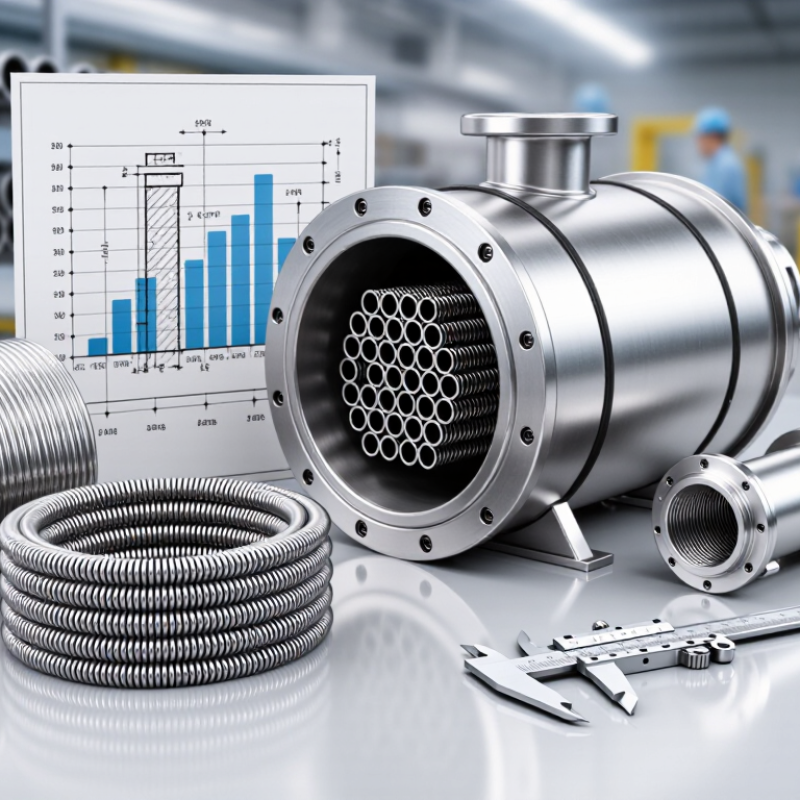
A titanium tube coil heat exchanger transfers heat between two fluids without mixing them. One fluid flows through a coiled titanium tube, while the other passes around its outer surface. Heat crosses the tube wall. Titanium offers strong corrosion resistance, especially in seawater, chlorinated water, and several chemical environments. It also remains reliable at elevated temperatures, when the design stays within its approved limits.
The coil shape creates a long heat-transfer path in a compact space. As fluid moves through the curved tube, turbulence can improve heat exchange. The surrounding fluid absorbs or releases heat across the titanium wall. Flow rate, temperature difference, tube diameter, wall thickness, and fouling all affect performance. A practical supplier should provide material certificates, pressure-test records, weld details, and thermal calculations. These documents matter more than attractive sales claims.
In field inspections, scale near the tube connections can reduce output quickly. Clean surfaces help.
Designers should also check galvanic compatibility with connected metals. This detail is easy to miss. Titanium is durable, but it is not automatically suitable for every fluid or pressure condition. I would verify chloride concentration, velocity, cleaning methods, and operating cycles before approving a quotation. Supplier experience with coil fabrication is useful, yet independent testing remains important. Some published capacity figures may assume ideal laboratory conditions. Actual systems are less tidy.
China Top Titanium Tube Coil Heat Exchanger Suppliers? – Titanium Tube Coil Heat Exchangers: Definition and Working Principles
Technical reference table for product evaluation, heat-transfer design, materials, and supplier qualification
| Data Dimension | Technical Item | Verified Reference Data or Explanation | Supplier Evaluation Focus |
|---|---|---|---|
| Definition | Titanium tube coil heat exchanger | A compact heat exchanger made from one or more titanium tubes formed into a coil. One fluid flows inside the tubes while another fluid flows around the external tube surface. | Confirm the coil geometry, heat-transfer area, connection arrangement, and intended operating fluids. |
| Working Principle | Indirect heat transfer | Heat passes from the hot fluid to the tube wall and then to the cold fluid without the two fluids mixing. The thermal path is convection, conduction through the titanium wall, and convection again. | Request a thermal design calculation showing duty, temperatures, flow rates, pressure drop, and safety factors. |
| Heat-Duty Formula | Heat-transfer capacity | Q = m × Cp × ΔT, where Q is heat duty, m is mass flow rate, Cp is specific heat capacity, and ΔT is the fluid temperature change. | Check that the stated heat duty uses consistent units and realistic fluid properties at the operating temperature. |
| Thermal Design | Overall heat-transfer relationship | Q = U × A × ΔTlm, where U is the overall heat-transfer coefficient, A is heat-transfer area, and ΔTlm is the log mean temperature difference. | Compare the calculated area with the required area and verify the fouling allowance and correction factor. |
| Flow Arrangement | Counter-current flow | Hot and cold fluids move in opposite directions. This arrangement generally provides a higher mean temperature difference and better thermal effectiveness than parallel flow. | Give preference to designs that clearly identify the flow arrangement and fluid-side velocity. |
| Tube Material | Commercially pure titanium Grade 2 | Grade 2 is widely used for corrosion-resistant heat-transfer tubing. Its thermal conductivity is approximately 16.4 W/m·K at 20°C, subject to specification and temperature. | Verify the material certificate, applicable ASTM or equivalent standard, and chemical composition. |
| Tube Material | Titanium Grade 5 | Grade 5 titanium, commonly known as Ti-6Al-4V, offers higher mechanical strength than commercially pure grades. Its thermal conductivity is approximately 6.7 W/m·K at 20°C. | Use only when the strength requirement justifies the higher material cost and lower thermal conductivity. |
| Corrosion Resistance | Seawater and chloride service | Titanium forms a stable protective oxide film and is highly resistant to seawater, many chloride-containing environments, and localized corrosion when properly selected and fabricated. | Review water chemistry, temperature, contaminants, galvanic-contact risks, and cleaning procedures before approval. |
| Tube Geometry | Common outside diameter range | Common titanium heat-exchanger tube outside diameters include approximately 6.35 mm to 25.4 mm. Actual selection depends on flow rate, pressure drop, cleaning requirements, and available space. | Check tube dimensional tolerances, ovality after coiling, bend radius, and access for inspection. |
| Tube Geometry | Wall thickness | Typical thin-wall heat-transfer tubing may use approximately 0.5 mm to 1.5 mm wall thickness, but the final value must be determined by pressure, fatigue, corrosion allowance, forming, and code requirements. | Do not approve wall thickness from a catalog alone; require pressure and mechanical calculations. |
| Coil Configuration | Helical or spiral coil | Coiled tubing provides a large heat-transfer area in a compact volume. Helical geometry can also promote secondary flow, although excessive curvature may increase pressure drop. | Compare coil diameter, pitch, number of turns, tube length, support method, and allowable pressure drop. |
| Manufacturing | Tube forming and bending | Cold forming or controlled mechanical bending may be used. The process must limit flattening, wrinkling, surface damage, and residual-stress-related defects. | Ask for bending-process controls, dimensional inspection records, and post-forming leak-test results. |
| Welding | Titanium welding requirements | Titanium welding requires effective inert-gas shielding, including protection of the weld pool and heated tube surfaces, because titanium reacts readily with oxygen, nitrogen, and hydrogen at elevated temperatures. | Review welding procedures, welder qualifications, shielding-gas controls, weld appearance, and non-destructive testing. |
| Connections | Tube-side and shell-side connections | Connections may include welded ends, threaded adapters, flanges, sanitary fittings, or custom headers. The connection style must match pressure, temperature, cleanliness, and maintenance requirements. | Confirm connection standards, gasket compatibility, orientation, drainability, and replacement-part availability. |
| Pressure Design | Operating and design pressure | Pressure capability is not a universal value. It depends on tube diameter, wall thickness, titanium grade, temperature, weld quality, coil geometry, fatigue loading, and applicable design code. | Require a design-pressure statement, hydrostatic or pneumatic test procedure, and documented allowable stress basis. |
| Temperature Design | Operating temperature | The permissible temperature range depends on titanium grade, pressure, fluid chemistry, thermal cycling, seals, and connected components. Material selection should be based on the complete service envelope. | Provide normal, minimum, maximum, start-up, shutdown, and upset temperatures to the supplier. |
| Hydraulic Performance | Pressure drop | Pressure drop is affected by tube length, internal diameter, flow velocity, viscosity, coil curvature, fittings, and fouling. A lower tube diameter can increase heat-transfer coefficients but may raise pumping requirements. | Request separate tube-side and shell-side pressure-drop calculations at minimum, normal, and maximum flow. |
| Fouling Control | Surface cleanliness and scaling | Although titanium resists corrosion, deposits can still form from suspended solids, biological growth, mineral scale, or process contamination. Fouling reduces heat transfer and increases pressure drop. | Confirm fluid filtration, cleaning method, drain design, access for flushing, and recommended maintenance intervals. |
| Testing | Leak and pressure testing | Typical quality controls may include visual inspection, dimensional inspection, hydrostatic testing, helium or air leak testing where appropriate, and weld non-destructive examination. | Define test pressure, hold time, acceptance criteria, test medium, calibration status, and required inspection records. |
| Quality Documentation | Material and manufacturing records | Important records include material test certificates, heat numbers, welding procedure documentation, inspection reports, pressure-test certificates, dimensional drawings, and packing lists. | Ensure traceability from the titanium tube heat number to the finished coil and final inspection report. |
| Supplier Qualification | Technical capability | A qualified supplier should demonstrate experience with titanium tubing, coil forming, titanium welding, heat-exchanger calculations, pressure testing, and corrosion-sensitive applications. | Evaluate process capability and documented quality systems rather than relying only on product photographs or advertised capacity. |
| Supplier Qualification | Quotation information required | A meaningful quotation should include heat duty, fluid names, flow rates, inlet and outlet temperatures, design pressure, design temperature, materials, dimensions, connections, testing, delivery scope, and warranty terms. | Reject quotations that provide only a nominal coil size without a duty calculation or operating-envelope confirmation. |
| Application Suitability | Typical applications | Common applications include seawater cooling, saltwater systems, aquaculture, chemical processing, pharmaceutical equipment, food-process heating or cooling, condensers, and compact process skids. | Match the titanium grade, surface finish, connection design, and cleaning method to the specific industry requirements. |
| Cost Factors | Commercial comparison | Total cost is influenced by titanium grade, tube dimensions, coil length, heat-transfer area, fittings, welding complexity, testing, documentation, packaging, shipping, and installation requirements. | Compare total installed cost and lifecycle performance, not only the initial purchase price. |
| Selection Summary | Best-fit design criteria | The most suitable titanium tube coil heat exchanger balances heat duty, compactness, corrosion resistance, pressure drop, cleanability, inspection access, and lifecycle cost. | Use a weighted technical evaluation covering thermal, mechanical, materials, quality, delivery, and after-sales requirements. |
Technical note: Final dimensions, allowable pressure, temperature limits, heat-transfer coefficients, and material selection must be confirmed by a qualified engineer using the actual fluid properties, operating conditions, applicable design code, and project safety requirements.
FAQS
Titanium’s natural oxide layer resists seawater, chlorides, and many aggressive fluids. This can reduce corrosion-related replacements. Long service life is possible.
A coiled tube creates substantial heat-transfer area within a compact footprint. This helps when tanks or equipment rooms have limited space. Small space, useful capacity.
Common applications include cooling tanks, chemical processing lines, and marine thermal systems. Proper design supports repeated temperature changes and stable flow.
No. Titanium has lower thermal conductivity than copper. A larger surface area may be necessary for the same heat-transfer duty. That can increase cost.
Confirm fluid chemistry, operating pressure, temperature, flow rate, titanium grade, tube diameter, and wall thickness. Connection design also affects performance and service life.
Request material certificates, pressure-test records, welding procedures, weld inspection results, and production traceability. Clear design calculations are important. Vague paperwork is a warning sign.
Request a sample or small trial order before volume production. Inspect scratches, uneven bends, discoloration, and visible weld defects. Photos alone are insufficient.
Ask about hydrostatic, helium, and dimensional testing. Confirm whether the complete assembly is tested, rather than individual tubes only. That distinction matters.
A removable design helps when cleaning access, inspection, or future maintenance is important. It may simplify tank work. Sometimes, fixed designs are unnecessarily difficult.
Compare at least three suppliers, but do not judge quality by price alone. Verify production capacity, recent inspection reports, packaging, warranty terms, and spare-part support. Delivery dates can look precise and still shift. Recheck them.
Conclusion
A Titanium Tube Coil Heat Exchanger is a compact thermal transfer system that uses coiled titanium tubing to move heat between fluids without direct mixing. Its design supports efficient heat exchange in limited spaces, while titanium offers excellent resistance to corrosion, seawater, chlorides, and many aggressive process environments. These features make the equipment suitable for demanding applications such as chemical processing, marine systems, desalination, food production, and industrial cooling or heating.
When evaluating Chinese suppliers, buyers should examine tube grade, coil design, welding quality, pressure and temperature ratings, production capacity, testing procedures, and customization capabilities. Reliable manufacturers should provide clear technical documentation, dimensional inspection, leak testing, material traceability, and compliance with relevant international or project-specific standards. Purchasing decisions should also consider total operating cost, delivery schedules, maintenance access, after-sales support, and the supplier’s experience with similar working conditions. Comparing these factors helps buyers select a safe, durable, and efficient system that matches their fluid properties and heat-transfer requirements.