Titanium Industry
Blog & Technical Insights
Discover technical guides, industry trends, and material innovation insights from Almerca Titanium Industry Co., Ltd.
Material Engineering &
Application Standards
Comprehensive updates on ASTM, ASME, and ISO standards for global titanium procurement.
7 Tips for Buying Titanium Seamless Tubes Globally?
Table of Contents
- Define Titanium Seamless Tube Grades, Standards, and Applications
- Verify Manufacturer Qualifications, Certifications, and Production Capabilities
- Compare Dimensions, Tolerances, Surface Quality, and Testing Requirements
- Evaluate Global Pricing, Shipping Terms, Lead Times, and Import Duties
- Confirm Quality Documents, Inspection Procedures, Warranty, and After-Sales Support
- FAQS
- Conclusion
- Related Posts
Buying Titanium Seamless Tubes across borders can look simple on a supplier’s website. The real work begins after the quotation arrives. Alloy grade, tube dimensions, wall tolerance, surface condition, and delivery terms can change the purchase decision quickly. A polished product photo proves very little.
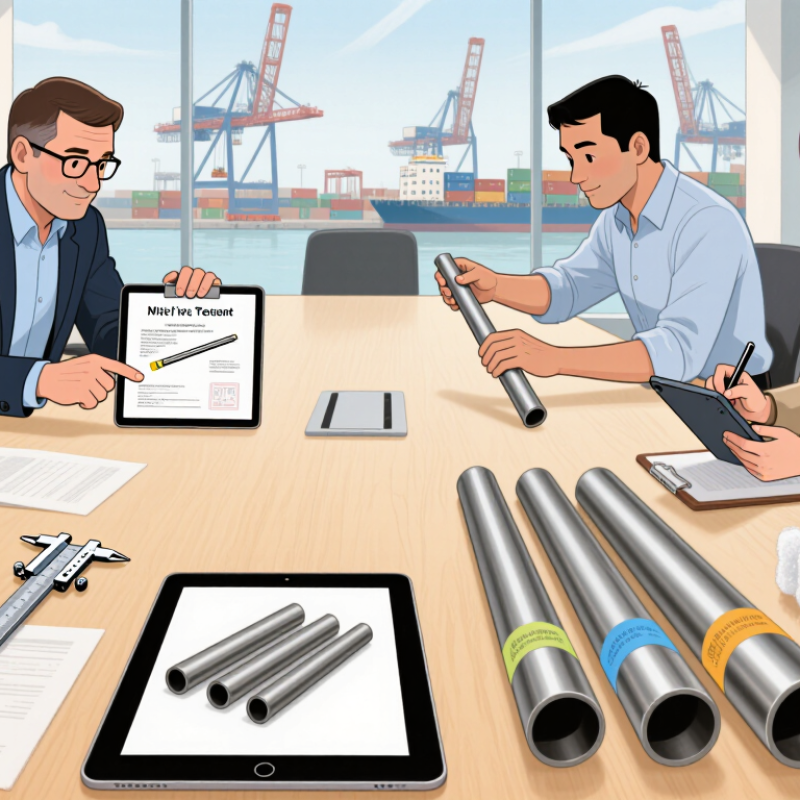
This guide presents seven practical tips for global buyers. It focuses on supplier verification, material standards, inspection records, and shipment planning. Experienced purchasers usually request mill test certificates, heat numbers, chemical analysis, tensile results, and non-destructive testing records. They also compare the certificate details with the physical markings on each bundle. Small mismatches deserve attention.
Standards matter. Depending on the application, buyers may review ASTM B861, ASTM B338, ASTM B829, or relevant customer specifications. The correct reference depends on the tube’s service, alloy, and manufacturing route. A supplier should explain this clearly, not simply list certificates. Ask about ultrasonic testing, dimensional inspection, packaging, and traceability before placing an order.
Do not trust the lowest price automatically. Titanium prices reflect sponge costs, machining, inspection, packaging, freight, and currency changes. A cheaper quote may exclude testing or use a longer production schedule. I have seen buyers focus on price and overlook tolerance control. That mistake can create costly fitting problems later.
Global purchases also require careful communication. Confirm Incoterms, payment stages, export documents, insurance, and delivery responsibility in writing. A capable supplier answers technical questions with evidence and realistic limitations. No supplier is perfect. A checklist can still miss something. Buyers should review risks with engineers, inspectors, and logistics partners before committing to Titanium Seamless Tubes. Reliable decisions come from documented facts, not confident promises.
Define Titanium Seamless Tube Grades, Standards, and Applications
Buying titanium seamless tubes globally starts with grade, not price. Grade 2 offers strong corrosion resistance and useful formability for chemical equipment and heat exchangers. Grade 5, commonly containing aluminum and vanadium, provides higher strength for aerospace structures and demanding mechanical parts. Grade 9 can suit applications needing lower weight and better formability. The choice can still be imperfect. Designers sometimes specify Grade 5 when Grade 2 would perform adequately.
Check the standard carefully. ASTM B861 covers seamless titanium and titanium alloy pipe, while ASTM B338 covers seamless and welded tubes for condensers and heat exchangers. These documents define chemistry, tensile properties, dimensions, and testing requirements. Compare wall thickness, outside diameter, length tolerance, surface condition, and allowable ovality. A mill certificate should identify heat number, grade, chemical results, mechanical tests, and traceability. Do not accept “titanium tube” as a complete specification.
Application details determine the real risk. Chloride-rich seawater, acidic process fluid, high temperature, and cyclic pressure require different verification. Request ultrasonic or eddy-current testing when service consequences are serious. Confirm whether the tube needs annealing, pickling, or special cleaning. The USGS Mineral Commodity Summaries 2024 estimated global titanium sponge production at about 210,000 metric tons in 2023, showing a substantial but concentrated supply base. Delivery claims deserve scrutiny. Review country of origin, inspection records, packaging, and independent test reports before payment, because a perfect certificate cannot repair an unsuitable grade.
Verify Manufacturer Qualifications, Certifications, and Production Capabilities
When buying titanium seamless tubes globally, verify the manufacturer before comparing price. Request its current ISO 9001 certificate, accreditation scope, audit status, and manufacturing address. ISO’s Survey 2023 recorded 1,265,216 ISO 9001 certificates across 189 countries and economies. That number shows certification is common, not automatically meaningful. A certificate can look convincing and still be irrelevant.
Check whether the scope covers titanium tube production, heat treatment, testing, and traceability. Ask for recent reports against ASTM B861 or the specification required by your application. Each report should identify the heat number, chemical composition, tensile results, dimensions, and inspection method. EN 10204 3.1 documentation is useful, but independent third-party inspection may be wiser for critical orders. Do not accept copied sample documents.
Production capability needs physical evidence. Confirm melting or approved billet sourcing, extrusion, cold reduction, annealing, straightening, and surface finishing equipment. Ask about ultrasonic or eddy-current testing, hydrostatic testing, and calibration records. ISO 9712-qualified personnel can strengthen non-destructive testing credibility. The U.S. Geological Survey reported approximately 280,000 metric tons of global titanium sponge production in 2023, yet sponge availability does not prove tube-making competence. Capacity claims need schedules, equipment lists, and sample records. Small gaps matter. Suppliers may overlook them. You should not.
7 Tips for Buying Titanium Seamless Tubes Globally
Verify manufacturer qualifications, certifications, traceability, testing procedures, dimensional control, production capability, and export documentation. The chart compares representative minimum mechanical-property requirements for commonly specified titanium grades under ASTM B861; always confirm the applicable standard edition and product condition.
Higher strength does not automatically mean better suitability. Match the grade to service temperature, corrosion environment, pressure, weldability, and the purchaser’s required inspection and certification documents.
Compare Dimensions, Tolerances, Surface Quality, and Testing Requirements
Buying titanium seamless tubes globally requires more than comparing price per kilogram. Start with the drawing, not the supplier’s catalog. Confirm outside diameter, wall thickness, length, alloy grade, and delivery condition. Ask whether dimensions use millimeters or inches. A small conversion error can affect fit. It happens more often than expected. Define dimensional tolerances before requesting quotes. Standard tolerances may not suit pressure, heat exchanger, or precision assembly work. Require an inspection report showing actual measurements from each production lot.
Surface quality deserves direct attention. Ask how the tubes were cleaned, pickled, polished, or machined. Look for scratches, laps, discoloration, embedded particles, and rough marks. Seamless does not mean flawless. Request a stated roughness value when fluid flow or fatigue matters. Photos help, but they cannot replace inspection. A sample should be checked under controlled lighting and measured with suitable gauges. I would not approve a bright surface by appearance alone; it may hide shallow defects.
Testing requirements should match service conditions and destination rules. Specify chemical analysis, tensile testing, hardness, hydrostatic testing, and non-destructive examination where needed. Require heat numbers, traceability, calibration records, and certificates signed by qualified personnel. Clarify sampling frequency and acceptance criteria in the purchase order. One weakness in my sourcing practice was assuming “tested” meant fully documented. It did not. Independent inspection can reduce uncertainty, although it adds time and cost. Agree on packaging, moisture protection, and document review before shipment.
Evaluate Global Pricing, Shipping Terms, Lead Times, and Import Duties
Buying titanium seamless tubes globally requires more than comparing the quoted price. Check seven points: material grade, outside diameter, wall thickness, tolerance, certification, Incoterms, and landed cost. Ask for mill certificates, ultrasonic testing records, and sample dimensions. A low EXW price may hide inland transport, export handling, insurance, and destination charges. Compare equivalent FOB, CIF, or DDP quotations.
Freight planning needs evidence. UNCTAD’s Review of Maritime Transport 2024 reported that global maritime trade grew about 2.4% in 2023, while route disruptions increased schedule uncertainty. Request a production lead time and a separate transit estimate. Add buffer days for port congestion and customs inspection. Small shipments can also face disproportionate handling fees. A spreadsheet is not proof. Confirm every charge with the forwarder and customs broker.
Import duties depend on the correct HS classification, origin, and trade agreement. The WTO World Tariff Profiles 2024 reported a global average applied MFN tariff of 8.8% in 2023, but titanium tube rates can differ considerably by market. Verify the exact tariff line through an official customs database before signing. Include duty, VAT, brokerage, testing, and storage in the landed-cost model. One recurring mistake is trusting an old tariff code. Recheck it when the tube specification changes. Allow time for correction.
7 Tips for Buying Titanium Seamless Tubes Globally: Evaluate Global Pricing, Shipping Terms, Lead Times, and Import Duties
A practical comparison table for international sourcing, quotation review, logistics planning, and landed-cost evaluation.
| Tip | Evaluation Dimension | Typical Market Reference | Commercial Data to Request | Logistics and Import Considerations | Recommended Buying Action |
|---|---|---|---|---|---|
| 1 | Define the exact tube specification Grade, dimensions, finish, and standard |
Common commercially used grades include Grade 2 for corrosion-resistant applications and Grade 5 for higher-strength applications. Typical seamless-tube dimensions may range from approximately 6–100 mm outside diameter and 0.5–10 mm wall thickness, subject to mill capability. |
ASTM B861 or equivalent OD and wall tolerance Length tolerance Surface finish Ultrasonic or hydrostatic testing | Non-standard sizes and short lengths generally increase manufacturing cost and may require a minimum order quantity. Confirm whether cut lengths, end finishing, and protective packaging are included. | Issue one standardized RFQ containing grade, outside diameter, wall thickness, length, quantity, testing requirements, certificates, packaging, and destination port. This prevents suppliers from quoting different product specifications. |
| 2 | Compare global pricing on a landed-cost basis Do not compare unit prices alone |
Indicative international titanium tube pricing can vary widely, commonly around USD 35–120 per kg for standard commercial quantities. Small lots, Grade 5 material, tight tolerances, and special testing can exceed this range. | Price per kg Price per piece Currency Minimum order quantity Tooling or setup charges Validity period | Add export packing, inland transport, freight, insurance, customs clearance, duties, taxes, inspection, and destination delivery before selecting the lowest offer. | Request at least three comparable quotations and convert every offer to the same basis, such as landed cost per kg delivered to the buyer's facility. |
| 3 | Choose the appropriate Incoterms® rule Clarify cost, risk, and responsibility |
FCA is useful when the buyer controls international freight. CIP includes seller-arranged carriage and insurance to the named place. DAP delivers to the named destination but normally leaves import clearance and import taxes to the buyer. DDP places most import obligations on the seller where legally and operationally feasible. | Named place or port Freight inclusion Insurance coverage Export clearance Import clearance | Incoterms® rules do not determine ownership transfer, payment timing, product conformity, or applicable customs duty. These items must be stated separately in the purchase contract. | Use the same Incoterms® rule and named location for all suppliers. For a first transaction, define who will act as importer of record and who will provide customs documentation. |
| 4 | Build a realistic lead-time plan Separate production from transport |
Standard-size seamless tubes may require approximately 4–8 weeks for production. Non-standard sizes, special testing, or low-volume orders may require 8–14 weeks. Ocean transit commonly adds about 3–8 weeks, depending on route and port congestion. | Mill production time Inspection time Certificate release Port-to-port transit Customs clearance buffer | The quoted lead time may begin after deposit, drawing approval, or technical approval. Customs holds, transshipment, port congestion, and document errors can extend delivery. | Ask for a milestone schedule covering order confirmation, raw-material allocation, production, inspection, packing, dispatch, estimated arrival, and document submission. Add a contingency buffer for critical projects. |
| 5 | Verify origin, quality, and traceability Control technical and compliance risk |
A credible material package normally includes a heat or batch number, chemical composition, mechanical properties, dimensions, inspection results, and a certificate of conformity. The applicable standard should match the purchase order. | EN 10204 3.1 certificate Heat number traceability Chemical analysis Tensile and yield results Nondestructive test report | Country of origin can affect preferential tariff eligibility, marking requirements, trade remedies, and customs documentation. Origin should be supported by production records rather than assumed from the shipping location. | Make certificate delivery, permanent marking, packaging identification, and independent pre-shipment inspection contractual requirements. Retain samples or photographs when practical. |
| 6 | Estimate import duties and taxes correctly Use the correct tariff classification |
Titanium tubes are often considered under the HS heading 8108, with the precise subheading depending on the product form and national tariff schedule. Duty rates may range from 0% to more than 10% by destination, origin, and trade arrangement; this is not a universal rate. | HS code confirmation Customs value Country of origin Preferential certificate Anti-dumping or safeguard check | Import VAT or GST is generally calculated according to local rules and may apply to the customs value plus freight, insurance, and duty. Brokerage, port fees, and inspection charges are separate from customs duty. | Obtain a written classification view from the destination customs broker or customs authority before ordering. Calculate a duty scenario using the highest plausible rate until the classification is confirmed. |
| 7 | Protect the shipment and contract Reduce damage, delay, and payment exposure |
Titanium tubes should be protected from contamination, moisture, impact, and surface damage. Suitable practices include clean internal separators, capped ends where appropriate, moisture-resistant outer packaging, and clear bundle identification. | Packaging specification Cargo insurance Payment milestones Inspection and rejection terms Warranty period | The buyer should confirm whether insurance covers the full invoice value, freight, and foreseeable transport risks. Check whether wooden packaging complies with destination-country phytosanitary requirements. | Use a purchase contract that defines acceptance criteria, allowable dimensional deviations, document deadlines, claims procedure, late-delivery remedies, and the governing Incoterms® rule. Link the final payment to document and inspection approval where commercially feasible. |
Reference note: Prices, lead times, freight costs, customs classifications, and duty rates are indicative planning ranges only. Actual results depend on grade, dimensions, quantity, origin, destination, trade agreement, carrier, and current tariff schedules. Confirm the applicable HS subheading, customs value, taxes, and trade remedies with the destination customs authority or a licensed customs broker before purchase.
Confirm Quality Documents, Inspection Procedures, Warranty, and After-Sales Support
Buying titanium seamless tubes internationally demands more than a competitive quotation. Request mill test certificates for every production lot. These should state the titanium grade, chemical composition, dimensions, mechanical properties, heat treatment, and traceability details. Confirm that the documents match the purchase order and required technical standard. Ask whether testing was completed by the producer or an independent laboratory. Do not rely on a polished PDF alone. Verify certificate numbers and original records when possible.
Agree on inspection procedures before production begins. Define sampling quantities, surface checks, dimensional tolerances, and suitable non-destructive testing. Ultrasonic or eddy-current testing may reveal flaws that visual inspection misses. Include calibration records for gauges and testing equipment. A qualified third-party inspector can witness production and final checks. Set clear acceptance criteria, not vague promises of “high quality.” A common oversight is inspecting only the first shipment. Later lots deserve the same discipline. No checklist catches every risk.
The warranty should specify coverage, duration, claim evidence, and remedies for nonconforming tubes. Clarify when coverage starts: shipment, delivery, or customer acceptance. Discuss packaging, storage, corrosion concerns, replacement timing, and transport responsibility. After-sales support should include a named contact, response times, investigation steps, and technical guidance. Request sample claim forms and previous corrective-action records if available. I would not assume a friendly sales conversation equals dependable support. Written terms matter more. Suppliers may make mistakes, and buyers can misunderstand specifications; a transparent correction process protects both sides.
FAQS
Compare grade, outside diameter, wall thickness, tolerance, certification, Incoterms, and landed cost. A low EXW price may hide inland transport and destination charges. Compare equivalent FOB, CIF, or DDP offers.
Request mill certificates for every production lot. They should show grade, chemical composition, dimensions, mechanical properties, heat treatment, and traceability. Check each certificate against the purchase order. A polished PDF is not enough.
Confirm certificate numbers and original records when possible. Ask whether testing came from the producer or an independent laboratory. Check that lot numbers match the shipped tubes. Small mismatch, big concern.
Define sample quantities, surface checks, dimensional tolerances, and non-destructive testing. Ultrasonic or eddy-current testing may find hidden flaws. Request calibration records for gauges and testing equipment. Do not inspect only the first shipment.
Request separate production and transit estimates. Add buffer days for port congestion and customs inspection. Small shipments may face surprisingly high handling fees. A spreadsheet is not proof.
Include the product price, freight, insurance, duties, VAT, brokerage, testing, and storage. Confirm every charge with the forwarder and customs broker. One missing fee can distort the comparison.
Confirm the exact HS classification, origin, and applicable trade agreement. Use an official customs database before signing. Recheck the tariff line when specifications change. Old codes create avoidable problems.
Define coverage, duration, claim evidence, remedies, and the coverage starting point. Clarify packaging, storage, corrosion concerns, replacement timing, and transport responsibility. Name a support contact and response time. Friendly conversations are not enough.
Suppliers can make mistakes, and buyers can misunderstand specifications. Written correction steps protect both sides. Request claim forms and previous corrective-action records when available. No checklist catches every risk.
Conclusion
Buying Titanium Seamless Tubes globally requires more than comparing prices. Start by identifying the correct titanium grade, applicable standards, and intended application, since requirements for aerospace, chemical processing, medical, and industrial systems can vary significantly. Carefully verify each manufacturer’s qualifications, certifications, equipment, production capacity, and experience with the required tube specifications. Compare dimensions, wall thickness, tolerances, surface condition, and testing requirements to ensure the products will perform reliably in service.
A complete purchasing evaluation should also include total landed cost, payment and shipping terms, lead times, packaging, and potential import duties. Before placing an order, request material certificates, inspection reports, traceability records, and details of the supplier’s quality-control procedures. Clarify acceptance criteria, warranty coverage, claim handling, and after-sales support in writing. A structured comparison of technical, commercial, and service factors will help buyers select Titanium Seamless Tubes that meet project requirements while reducing delivery risks and unexpected costs.

Blog Tags: